It was the moment first-light shape-shifted – imperceptibly transmuting from astronomical to nautical dawn – and, although my vision had long adapted to the gelid gloom, all I could discern ahead (as if insinuating myself deep into one of Dürer’s Meisterstiche…) were motionless, almost monochroic strata of indecipherable spectral shades: pitch against jet against coal, against ebony, soot and sable. And yet I sensed them, stock- and stand-still. As, assuredly, they sensed me.
“Beautiful writing. Each word pulls you towards the next in effortless momentum. Very much enjoy your work.”
— Mark Peter Beeson
“I love your blog! You write so beautifully.”
— Oliver Ryan
Showing posts with label Charlecote Park. Show all posts
Monday, 9 January 2017
Monday, 22 February 2016
Foretelling spring…
The trick with many a National Trust property (if not all…) – whether or not you want to nip into the restaurant for a sneaky coffee and breakfast flapjack (which I did…) – is to get there early. At Charlecote Park, this morning, just after opening time, there were definitely more gardeners than walkers; and most other visitors were confined (sensibly) to the Orangery: which was doing a steady trade in warming drinks.
Out on the paths, the few fellow hardy souls I encountered – weathering the chill wind; wishing for the uncertain sun to stumble through the scudding greyness – were far between: a brace of well-insulated toddlers, with their dad, viewing the heavily-pregnant Jacob sheep with awe, before pouncing through the frequent puddles to collect freshly-fallen twigs; and a couple of sensibly-dressed folk with walking sticks, making light work of the soggy trails through West Park (so damp that the frequent imprints of cloven hooves were remarkably deep and distinct – see photograph – with only the occasional evidence of a surprised skid). Even those responsible fallow deer were somewhat somnolent; and the journeys there and back were also notable for their curious (rapturous) insufficiency of traffic – which enabled me to slow down, just a tad, momentarily, to observe the mini-murmuration of starlings that currently flows between Oxhill and Lower Tysoe.

Such quietude, of course, is my delight: and I was able to meander around the extensive parkland at my own, slow, pace; relishing the peace, and the resultant almost-springtime alertness of the wildlife around me – obviously unafraid of the solitary, plumped-up, quilted figure concealed by bush-hat, dark glasses, and fleece-lined trousers; my dirty boots the perfect camouflage!
On the edge of the Wilderness, a solitary, slender robin – the front of its folded wings painted with a fine streak of almost-white – called sporadically from one of the rungs of a zinc-coloured garden obelisk. Only after a few minutes – and a wary, querying stare that probed my very soul – did it then hop up onto the finial to carry on its territorial (or perhaps lovelorn) conversation with an echo from across the Avon.
The river, too, although still coloured with silt, flowed less ferociously than the last few weeks’ torrents – the only evidence of which (apart from the spongelike squelch of the lower ground) was a continuous contour of broken reeds, wooden splinters and miscellaneous dreck, strewn sinuously along the grass (and most noticeable in Place’s Meadow: whose two inhabitant swans sat within necking distance, lazily tugging at the circle of moist, green blades within a beak’s easy reach).

Later, in West Park, sadly – whilst having a one-sided conversation with the deer (mostly sat, ruminating; and mostly unbothered by me: only the youngest scurrying for shelter under the nearby lime trees) – I disturbed a kestrel (perhaps the one I had witnessed earlier, wafting above the Avon, on the other side of the house?) from its stump-of-a-dead-tree perch: but even this normally guarded falcon only flapped sluggishly to the nearest hanging branch, its beadiness now focused on this rude intruder, rather than hunting for its lunch.
So I wandered on. Past the tag-playing rooks, chatting and chauntering; occasionally flapping short distances en masse for no reason I could fathom, before resuming their prattle. And my incidental stealth was thus rewarded with a sight that still stops my breath: the gentle bobbing of a green woodpecker (my eye caught by its startling red mohican and glowing underbelly, as well as that signature, inverted arc), swinging low across the river, before finding a suitable branch for rest. The heron, rigid beneath, glanced momentarily at this harmless interloper – fish-spear of a beak temporarily raised in salute – then resumed its fluvial gaze, deep into waters that were opaque to my eyes.
A good day for wildlife, then – especially for espying birds of all sizes (frequent paired blackbirds; the exasperated mallards on the Dene; an overheard wren shrilling from inside a hedge; blue and great tits feeding on the few remaining nuts by the hide…) – and a feeling that a week of prophesied sunshine may well herald a new season (as well as the wearing of lighter clothes).
The hazel-blooms, in threads of crimson hue,
Peep through the swelling buds, foretelling Spring,
Ere yet a white-thorn leaf appears in view,
Or March finds throstles pleased enough to sing.
To the old touchwood tree woodpeckers cling
A moment, and their harsh-toned notes renew;
In happier mood, the stockdove claps his wing;
The squirrel sputters up the powdered oak,
With tail cocked o’er his head, and ears erect,
Startled to hear the woodman’s understroke;
And with the courage which his fears collect,
He hisses fierce half malice, and half glee –
Leaping from branch to branch about the tree,
In winter’s foliage, moss and lichens, drest.
– John Clare: First sight of Spring
Labels:
birds,
Charlecote Park,
deer,
flooding,
food,
National Trust,
nature,
sheep,
spring,
walking
Tuesday, 27 October 2015
So good they named it thrice: a photo essay…
While the surface may be interpreted as Victorian in character, Charlecote Park is a layered landscape, belonging to all of history, and to every visitor that has ever been and has yet to visit.
Landscape, rooted as much in the desire of what is to come as what has already been, is transient and ever changing.
– Eduard Krakhmalnikov: More than a Park: A Landscape History of Charlecote Park
A month or so ago, I wandered around my beloved West Park (which I had to myself) at Charlecote: and even then I could sense the change.
Ahead of the annual rut – which is now underway – the more senior fallow bucks were beginning to claim advantageous (and traditional) corners of the parkland for themselves.
The breeding herd was also a lot more skittish than normal: running and pronking away in series – often at the behest of one of those larger ‘master’ bucks – when, during the rest of the year, they would mostly ignore you, and treat your clicking shutter with utter disdain.
“Call me Beyoncé! I’ve been photographed more times than the Queen, you know. Yawn. Here we go again, Gladys.”
On Saturday, I was fortunate enough to be part of a small party observing the deer at daybreak – arriving at Charlecote before 06:30 (for first light at 07:12, and sun-up at 07:47).
However, a couple of hours later, we were rewarded with strong coffee (here served by volunteer – and supreme – photographer, Jana Eastwood) and bacon baguettes: so there was more than enough compensation for the early rising!
And, although – as Adam Maher, ranger (and genial educational genius) explained – it was really too warm (a balmy 10°C, as I parked the Bardmobile) for us to witness the rut in full swing. In fact, there was only one real brief-but-memorable moment of antler-on-antler action.
Nevertheless, throughout the stroll, we were so well-entrenched in the natural world (my boots still smell of deer) – “It may be fenced, but this is truly wild…” – that only a professional churl could have been in any way let-down.
The echoizing call and return of tawny owls accompanied our dark walk to the parkland; and, as the crack of dawn widened (and our pupils similarly adapted), it became obvious that, whilst we meandered between the serried lime-trees, we were being silently policed by a sparse cloud of bats, gracefully skimming the air just above our heads (another indication of a mild dawn, we were told).
Throughout, a sporadic, confrontational soundtrack of groaning, deep-belching bucks – a noise also redolent to my failing ears of a wooden ruler being repeatedly vibrated against an old school-desk: establishing and reinforcing hierarchy, as well as having a go at (but not always succeeding in) impressing the ladies, of course – scatter-gunned across the park.
One of the many fascinating facts of Adam’s that I will never forget is that the trees’ canopy in the park is a uniform and signature 1.7 metres from the ground – a true mark of the herd’s ability to gobble up tree-shoots and flail the bark; and cause major damage, if not carefully managed.
This is not helped at this time of year, firstly, by the incessant antler-rubbing – removing any remaining velvet before the rut; as well as then gathering ‘decorations’ of leaves or grass – and finally the scent-marking of branches, using glands above the bucks’ eyes.
However, if your palmate antlers aren’t symmetrical – like this poor guy I stumbled upon, pretending he wasn’t there, hiding in the grass – you may find that all this is for naught: as the does are less attracted to you. It seems that it’s not just human beings that are fussy about these things!
West Park had undergone a transformation since I was last there. Huge, dark stands stained the ground (which, in turn, besmears the bucks: who cover themselves in their own urine in the way we might use aftershave…) – strategically placed and constructed “to attract sufficient does to herd them into a harem” – although the leks (“a gathering of males engaging in competitive display to attract potential mates”) morphed lazily, this morning, as the younger bucks somewhat lethargically challenged and withdrew.
Occasionally, a doe would make a treacherous bid for freedom: and only then would the energy of the deer become apparent: as the master bucks dashed away to corral the errant female.
“You can see why the bucks can lose 40% of their body-weight during the rut,” commented Adam (who does a mean doe imitation call: a sort of whistled, feline mew, or squeak). And I thought to myself how much hard work it must be… (without drawing any parallels whatsoever, this time – please note – between creature and human…).
So – following a sleepless night; and a deep frost – I decided Sunday’s dawning might bring forth a little more “action”. In one way, it did: the sunrise was glorious. However, the majority of the deer – apart from one lone master buck: groaning and corralling his increasing harem – were extremely somnolent.
This ‘time-out’ allowed the other bucks to grab a bite to eat; preen; practice their stances and belches – half-heartedly, it has to be said – and then ruminate on their stands. “Nothing to see here.”
So, after well over two hours of well-layered and gloved perseverance – silent standing, mixed in with a little slow-motion strolling along the public footpath in West Park (the only access at this time of year); as the mist crept in hesitantly from the River Dene – I left the deer to it. No doubt, as soon as I left, they all went berserk – finally stuck in a rut….
Although my galleries are in desperate need of an update, my earlier deer photos can be found here – as part of my larger Charlecote collection: which also includes the many wonderful trees of West Park.
Saturday, 6 June 2015
Dull would he be of soul…
One of the most wonderful aspects of living in ‘The Three Tysoes’ is the amount of history – even if you excised my own sweet Will from the landscape – we are immersed in and surrounded by: and this is epitomized, I believe, by the National Trust, whose local range of properties provides me with ongoing inspiration; whose large swathes of gardens and parkland help keep me mobile; and whose diverse eateries keep me suitably sustained.
Over the last couple of weeks or so, my health has been good enough (and the weather kind enough) for me to do a mini-tour of some of my favourites – including our neighbour, Upton House and Gardens (top photograph), with its remarkable, evolving vistas; my habitual wonder-as-I-wander spot, Charlecote Park (at the bottom); the beauteous Baddesley Clinton (above – perfect for just sitting, reading, and thinking); Hidcote (the greatest garden I know – with such wonderful rooms and blooms, below – which is why I return so frequently); and Packwood House (next photograph): where it is easy to escape from the throng gathering for the Sermon on the Mount, and immerse yourself in the typical, Warwickshire landscape of rolling meadows, overflowing, at this time of year, with cow parsley, buttercups, and almost-hidden delights of tiny pale blues and purples ensconced deep within the myriad grasses.
It would be easy to take such places for granted, to treat them as the sole purview of the tourists who form the seemingly endless snaking backbone of our economy – but, as I have said several times over the last month, we are “so very fortunate” to have such settings to saunter through at our own leisure; at our own convenience; and so near at hand (and foot).
There are not many moments quite as thrilling as that when you realize you are the only soul in a garden such as Hidcote on a rainy day, or in Charlecote’s deer park in the snow: imagining that, however fleetingly, this is yours, and only yours; that this is your domain; your backyard (and not just in it…). Living in close proximity, we have that luxury: that we can indulge ourselves when others may find such places too remote or unseasonable; seeing each place anew again and again – and not just for their innate, crafted beauty; or their extensive historical context; but for the rich, relevant relaxation and deserved, diversionary depth they can bring to our restive lives.
Tuesday, 9 December 2014
A walk on the mild side…
Hi,
Just a quick email to say how useful I've found the blog, particularly as a prospective Tysoean (or Tysoenese, I defer to your experience in such matters). I’m moving your way, you see, and was wondering if you had any tips on where to wander first, what to look out for etc? Local intelligence and any advice much appreciated. No obligation, of course, but my wife and particularly poorly behaved collie want to put the right foot first, if you see what I mean.
Kind regards and keep up the good work,
Tom
Dear Tom –
Many thanks for your wonderful email – which I’m pretty sure is the first piece of ‘fanmail’ that I’ve received, in a year of writing (mostly) about the place I live; the place I love. You’re obviously possessed with excellent taste – both in writers and in villages – so feel free to give yourself a pat on the back; and why not treat yourself to a pint, the next time you find yourself in one of our local pubs!
Seriously, though, I’m glad the blog is both useful, and being read by people who don’t already live here (“Tysoeans”, I think – although that makes us sound vaguely mythical or mystical; inhabitants of an almost 21st-century Shangri-La: which, of course, isn’t too far from the truth…). I’m also pleased that it hasn’t dented your attraction to the place.
You may have to go elsewhere for “local intelligence”, though… – but, as to “advice” on where to wander: well, you’ll be spoilt for choice! When we moved here, we ordered an OS Select map from Ordnance Survey, centred on our new home: and we immediately discovered that there are footpaths galore spiralling out from the village, connecting us like a beautifully-designed walker’s web to our neighbouring villages, and beyond. Alternatively, you could grab yourself a copy of the local OS Landranger Map (151: Stratford-upon-Avon, Warwick & Banbury) – which will give you a wider range of places to explore.
So, where to go first? Well, although it currently lacks both its sails and its stocks, the windmill – on the appropriately-named Windmill Hill, between Upper Tysoe and Compton Wynyates – is an obvious landmark; and it’s up a hill (d’oh): so good exercise for all three of you! At 181 metres above sea-level, it is also a great place to survey your new domain – with wonderful views particularly north (overlooking the three Tysoes) and west (towards Shipston-on-Stour and Chipping Campden) – or, on a warm day, to have a leisurely picnic. (What do you mean: you left the wine chilling in the fridge?!)
Should you wish, instead of returning to the village, you can then wander over the far side of the hill – with your rucksacks lightened and tummies filled – down past the stunning Compton Wynyates house (sadly no longer open to the public), and across the fields – on the flat – to Whatcote or Oxhill: both of which have the requisite pub – the friendly Royal Oak and my favourite (especially for fine food), The Peacock, respectively.
If you take the path to Whatcote, you will eventually join the Centenary Way (which leaves Upper Tysoe via Tysoe Manor, one of the village’s many listed buildings). This path is well worth exploring in both directions: and, if you don’t mind the odd gradient, clambering up by Old Lodge Farm is the best way to get to our nearest National Trust property, Upton House – which has wonderful gardens, a great restaurant, and one of the best interiors of any stately home I know (especially if, like me, you’re a fan of interesting art and comfortable chairs!) – or even further along the Edge Hill ridge (famously overlooking the first pitched battle of the English Civil War).
Depending how new you are to the wider area, it contains a plethora of local National Trust properties (although not many will welcome a “particularly poorly behaved collie” I’m afraid – otherwise I would have raved about Charlecote Park: which is home to a herd of fallow deer and a flock of Jacob sheep); and Stratford-upon-Avon itself is good for gentle strolls down by the River Avon, or up into the Welcombe Hills. (Have a look at my online Warwickshire photo gallery, if you need further inspiration; or take a peek at my list of Local links.)
But you don’t always have to leave the village (Mrs Bard particularly enjoys exploring the area around the Epwell Road): as there are byways through, and connecting, all parts of it – and all pretty much on the flat – so, when I’m feeling less energetic (which is pretty much my default mode, at the moment), I’m happy just to toddle along the back lanes to the church and back; or, following the footpath beyond the church and primary school, stretch my legs as far as Lower Tysoe. As I’ve said before, “the three hamlets – from Tysoe Manor to Lane End Farm – are less than two miles from end-to-end (and that’s using the roads; not cutting corners with our frequent footpaths, or as the numerous crows fly…)”: so it’s no great strain, and there is much to be enjoyed (including a wide selection of wildlife) – whichever direction you head in!
Hopefully, this will have given you a few ideas, for once you’ve settled in (or just can’t be bothered unpacking the twentieth box of the morning…). Welcome to Tysoe! I hope the place brings you many happy times and memories.
The wheel of heaven turns above us endlessly
This is all the heaven we got, right here where we are in our Shangri-La.
– Mark Knopfler: Our Shangri-La
Labels:
Centenary Way,
Charlecote Park,
Compton Wynyates,
countryside,
dogs,
Edgehill,
Oxhill,
photography,
Stratford-upon-Avon,
village,
walking,
Warwickshire,
Welcombe Hills,
Whatcote,
windmill
Saturday, 4 October 2014
Won/Nothing: in a game of two halves…
Ranging from high drama to low farce (which is very, very funny indeed – with echoes of the Keystone Cops and Harold Lloyd (sans specs)), Love’s Labour’s Won – really Much Ado About Nothing – follows on beautifully (and remarkably well) from its companion Love’s Labour’s Lost – using a slightly shuffled cast (from the same company of players) to complement it; as well as sharing a setting, in my cherished Charlecote Park.
Keeping Edward Bennett (Berowne/Benedick) and Michelle Terry (Rosaline/Beatrice) as the central pair also helps link the two plays – a pair of sparkling actors, in “a pair of sparkling comedies [that] belong together”, as Greg Doran states in the programme – although this one has a much more optimistic (and complete) ending: which, carrying on after the first ‘curtain call’, just keeps coming back for more song and dance! (Extra time, perhaps…?)
This play wins on momentum, perhaps – it “hath indeed better bett’red expectation than you must expect of me to tell you how…” – but takes joint honours in the early-twentieth-century period “excellent music” (by Nigel Hess; directed by John Woolf – including a very moving post-interval company rendition of Holst’s setting of Christina Rossetti’s In the bleak mid-winter…) – and costume (supervised by Samantha Pickering). It also features a dancing star of a Christmas tree topper that I hope the RSC will be selling in their shop as a seasonal, Shakespearean ornament available to all…!
The revelation of the (preview) night, for me, was the multi-talented Harry Waller’s self-deprecating “ill singer” Balthasar, accompanying himself on the piano for a wonderful rendition of Sigh no more, ladies. Only a footman in Love’s Labour’s Lost, his warm voice perfectly fits the post-Edwardian era timbre of the play: making him more of a central figure than the text would perhaps suggest (only 33 lines – of which 23 are lyrics…) – “faith, thou sing’st well enough for a shift”.
If I had one criticism, it would be the casting of Sam Alexander (as the (legal and ethical) bastard, and personification of evil, Don John) and John Hodgkinson (as Prince Don Pedro) as half-brothers – when there is an age difference, in real life, of around twenty years. Although they both inhabit their rôles consummately, with depth and meaning, their somewhat lighter parts in Love’s Labour’s Lost – as the most conscientious monarch, and the affected Spanish braggart (and wonderfully cod-accented) Don Armado, respectively – mean that, initially, it can also be difficult to accept the serious nature of their ‘new’ characters: nonetheless, this does give both of them the vantage of demonstrating their great range.
As with the first, I shall be back to see this second play in a month or so (once more, with captions) – but tickets (I am told) are starting to get hard to come by: so if you want to join in the revelry – and this production of Much Ado would make a perfect pantomime-substitute – book now!
Postscript
By the way – as a walking stick user, with a mum who uses a crutch – I think I need to start a campaign to teach actors that supports always go on the good side – not next to your gammy leg. Don John may have limped consistently and convincingly, throughout: but he has obviously been watching too much House…!
Friday, 26 September 2014
The words of Mercury are harsh…
Another rip-roaring success at the RSC: although the rip comes markedly between the two halves of Christopher Luscombe’s imaginative production of Love’s Labour’s Lost – the first, a tour de force of wit, romance, banter, intimacy, and fantastical, breathtaking scene changes; the second, alternating farce with roaring songs of music hall variety, fading, until – as Hamlet says – “the rest is silence”; the characters (but not their players) are spent; and love’s labour is well and truly shredded by what artistic director Greg Doran has described as “the shadow of war”.
The first half is also better paced, I feel; and it will be interesting to return, later in the run, to see if the second then flows more smoothly, tightly, evenly. [It does: and therefore completes the play perfectly… – and a little quicker!] Consisting solely of Act 5, it is an extended diminuendo into that “silence” (but not peace…) – echoed in the simpler staging – and therefore pitch, tempo, and intensity (of sound and emotion), become very difficult to sustain and control.
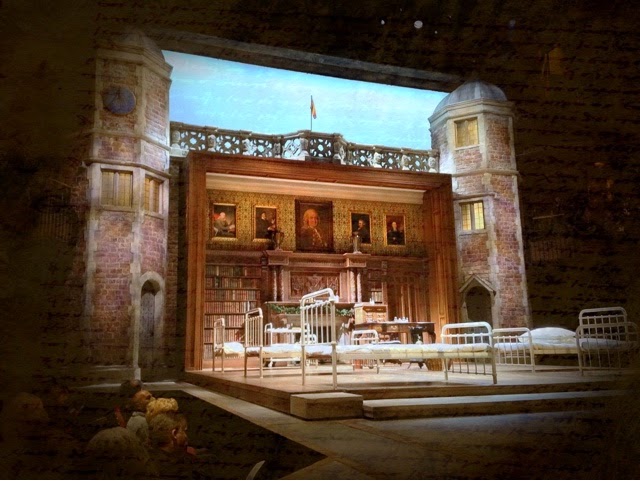
Set on the eve of World War I, in an astonishingly reimagined yet faithful Charlecote Park – courtesy of Simon Higlett (whose initials grace the main doorway and fireplace, along with Christopher Luscombe’s) and the miraculous RSC scenic workshop staff – the atmosphere, and the feel of this production – as well as the superb costumes, recreated period music (composed by Nigel Hess), mannerisms – are utterly consistent in their prelapsarian feel: with hints of the frothiness of the Twenties to come; but also of the horrors the world had to suffer to get there.
As just about always, with the RSC, the cast are uniformly excellent: obviously revelling in each other’s companionship – although I have to express slight reservations about Leah Whitaker’s Princess. Maybe it is the rôle of royalty to have to demonstrate more measured behaviour: but she seemed a lot less involved in the frivolities than her companions – and even I would have fallen for Sam Alexander’s cheeky charms (and bad poetry) as an almost Ian Hislop-like King…! – and she only really comes to life, ironically, when hearing of her father’s death; and then bidding her suitor “stay until the twelve celestial signs Have brought about the annual reckoning” before he may repeat his devout declaration of love.
Edward Bennett, as the witty – and occasionally flustered – Berowne rules supreme, though: making the most of the late Ian Richardson’s “favourite character in Shakespeare” – an actor’s dream of a part. His verbal jousting – although sometimes cruel, or perhaps thoughtless; beaten back, though, by Michelle Terry’s giving-as-good-as-she-gets Rosaline… – nearly always helps him, and his friends, escape from the sticky spots they put themselves in; and he ends up coming out on top (literally, in the roof scene, that ends Act 4 – surely where Dick Van Dyke should have made a guest appearance?!) for much of the time. It is easy to understand his well-earned popularity.
Special mention should also go to Tunji Kasim, as Dumaine (and a wonderfully mature Claudio in Love’s Labour’s Won…). A superb Edmund in David Farr’s 2010 production of King Lear at the Courtyard, I have a feeling he – and his teddy bear – will go very far indeed. Additionally, Nick Haverson’s Costard is a manic delight; as is Peter McGovern’s Moth; and Jamie Newall’s sardonic, laconic Boyet struggles not to steal every scene he is in.
In a play where language rules – the plot is thinner than the four friends’ disguise as “Muscovites or Russians”: drawing “out the thread of [Shakespeare’s] verbosity finer than the staple of his argument” – the production, somehow (especially in part one), keeps you gripped: only occasionally taking deep breaths, slowing the pace, before plunging headlong back into the action.
It will be fascinating to see, therefore, in a few days time, what the same company and creative team makes of Love’s Labour’s Won – in truth, Much Ado About Nothing – this time set after the war.
Monday, 31 March 2014
A little herd of England’s timorous deer…
The National Trust’s Charlecote Park is one of my favourite places to wander around: especially West Park – home to the main breeding herd of fallow deer. There is a grandeur in the mature tree-lined avenue down to the west gate, on the Stratford Road; and, the last time I was there, a great deal of mystery, until the fog – that had covered everything in a damp monochrome shroud – eventually lifted.
The contrast between West Park, and the rest of the estate, is quite marked; and is exemplified by the two groups of deer that populate each. In the main grounds, the deer are less timorous, and even quite approachable when in the right mood (usually during or after feeding); whereas those to the west – where the ground is more natural and wild – retain more of their essential character: especially as the presence of fawns makes the mothering does protective, and the fathering bucks permanently on-guard. Should the presence of the occasional human get too much – and they are a much rarer sight than the deer, on this side of the park – the herd also has the deer sanctuary to retreat to.
In the more visited areas, to the east and north of the house, the deer – bucks of all ages: kept, I think, mostly for decoration; and to make flesh of the legend of Shakespeare’s supposed poaching (and supposed retribution in his portrayal of the fusspot, Justice Shallow) – are outnumbered by both visitors and the wonderful flock of splotchy Jacob sheep. The sheep behave as sheep always do: grouping stochastically together, mimicking and following each other’s actions, intent on munching on as much grass as they can. Whereas the deer have become more domesticated: the presence of those strange upright creatures who seem intent on photographing their every move not being quite so alarming.
If you sit on a fallen tree, for instance, close to the ground where food has been scattered by their keepers, even the younger ones will quite happily – although occasionally glancing at you with barely concealed forbearance – wander within feet of you: not at all bothered by the constant clicking of your shutter; their simple minds intent, like the companion sheep, on filling their gullets.
Approach them when they are sated, or basking in the sun, and you will soon know when you have overstepped their boundaries. The less brave will rise, stand and stare – getting to their hooves in reverse order of fearlessness. The last to do so, though – if he can be bothered; and with a disdainful eye aimed towards your camera – will always be Boris: a large leucistic buck, with a face that bears witness to many rutting duels and skirmishes.
Why “Boris”? Well, with his pure white coat, and obvious leadership status – combined with his slightly ‘interesting’ facial features – there was no real alternative! He also seems keen on communicating; and I have seen him lower his head, ever so slightly, and walk purposefully, but slowly, towards those too curious to appreciate his personal space. It’s a message that is always read loud and clear (I believe that he is actually pretty chilled – he’s just become accustomed to bossing others about…); and I have never seen him concede the smallest amount of ground, unless he, and his cabinet, are majorly outnumbered – and then they will saunter away, prompted more by a desire to be left alone, rather than any concern for their safety. (If you have Boris defending you, there is probably very little that bothers you!)
The thick fog appeared to have left me with the park to myself – although, as the sun emerged, a scattering of other visitors appeared. However, I was alone, initially, when I popped into the Orangery Restaurant for my usual brunchfast of warming soup (which is always served with a very large chunk of fresh bread), moist treacle flapjack (there is none better), and steaming Americano.
The previous time I was here, I had the company of one of Charlecote’s resident, and characterful, cats: sitting, nuzzling, on my knee: occasionally staring intensely at his image, reflected back, on my iPhone. “Is this me?” However, Jasper – who had been an almost permanent gatekeeper for the restaurant: often trying to sneak in for warmth, company, or food (when, really, he knew better…) – died, a few days later; and the Orangery is a sadder place for his absence.
It is such individuals that make Charlecote – the humans: volunteers and staff alike; as well as the wild- and not-so-wild-life – as much of an attraction as it is the landscape and architecture. And they are a large part of the reason I return again and again: watching how the seasons affect them; making each visit different – whether a quick stroll to and from the restaurant, or a longer walk around the parkland. And, if I leave, with venison in my bag, like young Will, then it is probably only in the form of sausages, acquired legally, from the local produce shop in the Pantry!
Subscribe to:
Posts (Atom)