Showing posts with label depression. Show all posts

Thursday, 10 December 2020

A long December…

It may be down to the fact that I’m listening to – no: immersed in – Counting Crows a lot, at the moment (a very extended moment that has been absorbing me for many, many days): but there seems to be a preternaturally large number of black birds flecking, piercing, spiralling, twisting and weaving the air, at the moment. (That phrase again.)

Wednesday, 31 May 2017

Windmill Hill revelation…

The village yet damped-down beneath the oil of night; the only report, the high-pitched, mock-bark fracas of fox-cub. In the nucleus of nautical dawn, all is grey: green-grey grass; mauve-grey cloud; brown-grey stone; black-grey horizon – the world the colour of mallard, wood-pigeon, blackbird, and rook.

Leaving the Shipston road, the burble of an old valve radio being spun between stations grows with the wheat. My footsteps and stick-falls are silent, here: but still that splashing of song sooner turns trickle; soon turns stream; turns river; turns waterfall – drenching me in an incessancy of resonant comfort; drowned merry in a sea of skylarks. To my right, a crisp rustle of stalk. Then muffle of noiselessness. Only as I move on, the blades once more immobile, threat dissipated or dissolved, does the torrent of Matins restart.

Monday, 22 May 2017

Is this now My Hill…?

As far as I am concerned, the only thing that can be achieved, when both my mind and body are suffused with deep, thick, viscous torment (echoed by repeated, random interference in both ears: stereophonic sussurations of spite…) – as I have stated so many times before – is walking. Apart from summoning lurking asthma, I know there is little worse I can subject my aching frame to. Plus, of course, my depression will ease, the further my journey. And on a morning like this – clear skies and concomitant summer balm; goldfinch twinkling in the hedges; chaffinch in the fletching oaks; buzzard and skylark floating above; sheep lazily grazing (heavy in their winter coats); and cattle uniformly resting in the shallow corrugations of ancient fields – what else am I to do? It is too generous a day to be shackled by sheets and shocking stair-rods of pain.

The first mile is hard: as if battling through stacked mattresses. But, reaching the sown fields, resistance fades, and my limbs begin to move with supernatural ease. Through my second gate, the path flowing beneath me, last week’s fresh cowpats have been grilled by the new heat, drilled by flies; but fudged treachery lies beneath the further stampede of hoof-prints, incised as the cattle migrated to new pasture. Despite the surface-split soil, moisture lurks. I wonder for how long.

Thursday, 4 May 2017

Solvitur ambulando…

Walking is magic. Can’t recommend it highly enough. I read that Plato and Aristotle did much of their brilliant thinking together while ambulating. The movement, the meditation, the health of the blood pumping, and the rhythm of footsteps… this is a primal way to connect with one’s deeper self.
– Paula Cole

As part of my ongoing therapy, not only am I increasingly inhooped by a rising bricolage of motivational tomes and workbooks; but I find myself engulfed in periodic upsurges of rippling diaries, forms, and tables: a flux of unsullied A4 wavelets, tiding over me as temporary succour; busying me; until, eventually – when they are progressively overlaid with my records, registers, and particoloured responses – they crystallize into frangible stepping-stones, leading me steadily ashore. Rush ahead too expeditiously, though, and these will crumble, along with my tentative betterment. Forbearance is key – especially when allied with deep trust, hard listening, and terrifying honesty: the underpinnings of hope, if not yet achievement.

Tuesday, 18 April 2017

Faith, I’ll bear no base mind…

It is seven months and six days since I last donned my fervent walking boots and headed out of the front door in search of the spiritual nourishment only nature can provide – the act of doing so more psychologically and physiologically strenuous than I had initially envisaged. But such challenges are there for us to subjugate… if we are to be alive to our values (and alive for them). Should we let either external constraints or internally-driven apprehensions suppress (or even oppress) our compelling predilections and true-hearted desires, then surely our very identities and individualities are at risk of corruption or cessation.

Sunday, 5 February 2017

Anything different is good…

Introduction
I didn’t know it was National Time to Talk Day until the closing moments of my assessment in Warwick Hospital’s Clinical Health Psychology department – but it seemed such a neat coincidence that my appointment (last Thursday) should have taken place on such a significant date that any doubts I had rapidly faded. By the way, it was Groundhog Day, also. However, I’m still struggling to find an apposite correlation with that….

I like to see a man of advancing years throwing caution to the wind. It’s inspiring in a way.

My hesitancy had concerned the publication of what follows. But, if we’re going “to get talking and break the silence around mental health problems”, as I had previously done, eleven months ago – and without any real qualms – then this is what it’s going to take. Not just wearing “my heart upon my sleeve For daws to peck at”. But allowing those who care to have a wee peek inside: and see that “I am not what I am”.

Wednesday, 5 October 2016

When; and the art of existential transience…


For a relatively short time, I sobbed my heart out. But then, being the undoubtedly strange creature that I am – and, yet residing on its periphery, probably reasonably representative of my species… – I do seem to devote rather a lot of effort – as well as lend a disproportionate amount of significance to – mayfly moments such as this. It is as if – recognizing (whilst simultaneously attempting to avoid discussion of) our brittle mortality – we treasure the ephemeral above all else; venerate the transitory beyond rational measure. We see, reflected in such twinklings, I suppose, the entropy that must always prevail (until the only thing remaining is entropy itself); and therefore lend them as much love as we can, until they crumble to the sand by which, when captured in entwined glass globes, we would once (long ago) have measured their brief incidence; before mourning their finiteness. As I did.

All we can do, really, faced with such, is remember. Or, at the very least try to – however imperfectly filtered through our emotions and subjectivity. Surely, otherwise, these junctures lose the import that produced them; and – for a paltry while – that sustained them (and us). And, should our memories – the golden threads which fabricate the texture of our lives; the microscopic building blocks of the richness of our realities: ones we hand down, inadvertently, along with our atoms… – be fortunate, then perhaps they will survive, beyond our crumpled existence, as poor proxies. Thus, many lifetimes hence, those that follow (should they choose) can discern their value, gasp at their truths (again) – rather than simply, reflexively marvel at their endurance, the longevity of the poor surrogates themselves.


I cannot – even were I freakishly nominated as literary ambassador for all humankind – speak, speak to… others’ thoughts (unless similarly committed to posterity: stochastic samples of the privileged and able, perhaps; and, yet, I would hope, as contradictory and wide-ranging as those who selected me… but especially those who did not). All I know is that, pick any part of this blog, and – whether of a walk; a play; a concert; an encounter with the weather, or another soul… – the evidence before you would go a long way to demonstrating that my sole purpose here is in making inefficient attempts at tanning the hide of time, pickling the ineffable, pressing the fading petals of awe between my ever-mounting pages. No better than those proud, possessive Victorians displaying pinned moths by the caseload.

Yes, there are strong hints of their quick beauty; but, once slowed by my dull hand, am I in fact merely robbing the life, the mystery, the essential ‘beingness’ from that which I witnessed? Or should I continue to believe that – in pleasing (only) myself; and providing enough clues with my monochrome words to reconjure the original technicolour majesty, momentarily in (only) my head (should I dare to; care to…) – this is all I should be expected to be able to achieve?

Stumble upon the tens of thousands of still images, archived with a similar objective, and you might begin to suspect that, surreptitiously, I was either stashing them with the aim of posthumous fame; or, more likely, concerned that my raddled brain will increasingly require such prompts. (It would be nothing but vanity to imagine that they hold value to anyone but their creator… – words or pictures.)


And yet I persevere. And always will. Both in cherishing and recording. I feel I have no other option. If I only aim to do so to distract myself, though, then I fail. If all I achieve is to say “I was here”: then, again, there is no purpose. If, however, I write to proclaim my bewilderment at miracles frequently flashing by me – and that I managed to grasp a few of them, momentarily – then perhaps I am on to something. It may not be my “responsibility”, as such. But if I convey just to one other person just one fraction of that I experienced – so that the miracle is extended in time and space – then, maybe, maybe, I have a little justification.


For a short time, I sobbed my heart out. Not, this time, because of what I had seen or heard. But, for the third time in the same number of weeks, because the anticipation of such would lie unfulfilled. Yes, I can watch the DVD of the RSC’s production when it is eventually released; and I can also – as I did, over and over, on Monday evening – listen to the mesmerizing CD of the same performers playing one of the most intimately radiant pieces of music ever composed – instead of hearing it live. But, of course – some of it being down to that adoration of the temporal; most of it due to the ‘happeningness’ I seem to spend half my life waving a tattered butterfly net at… – it’s not the same. (It’s not that the digital domain is sterile – the passions are still utterly crystalline… – just that presence overloads every single one of your senses.)

All those months of drooling expectation; the prolonged crescendo of excitement; the knowledge that something so utterly exhilarating lurks over the horizon… – all dashed. Perhaps it is the anticipation – rather than the event – which renders it so special?

I am convinced that it is a combination of both. I am also convinced that not being able to realize the three-dimensional possibility so readily accrued distresses at least as much as the actualization would have comforted… – and carries with it all the poignancy (if not the force, the tragedy) of a life cut short. At this moment, it certainly feels as momentous – however inordinate I know that to be.


After all, it was just another point in time, a potentiality. And there have been many such that I have chosen simply to pass by. But I selected the ones that would eventually pass me by because they possessed something significant. They were fleeting, rare, coveted creatures that I will now never hold, even temporarily; therefore never stumblingly attempt to memorialize for others (and, in doing so, secure for myself). Scattered amongst the infinite possibilities of my life, they will haunt me: carving yet another notch into the wall of the cell that holds and punishes me (one that is, in my case, simply labelled ‘disability’) – one whose volume seems to decrease, almost imperceptibly (were it not for those sad markers), trapping me tighter with each vanquished wish…. (I could, though, treat them as ‘friendly’ ghosts: letting them help me rationalize, and gain proportion and balance. More straightforward to write than to execute, though…?)


So, I wonder – having tapped single-fingered at my iPhone for the best part of two hours – why do we cherish the transient so greedily? And then why do we – some of us – try to describe it; or at least cement its effects into our emotions? Surely the experience alone should be enough?

And, of course, for most, it is. And yet… we still purchase the CDs; replay the concerts on iPlayer; peruse the reviews; watch the DVDs until we know each line of dialogue, weep and laugh in the same places…. But then, I wonder – an epiphany prompted by an insomniac stroll… – if, “for most”, this is actually what suffices, even excites… – if only a minority of us genuinely crave the imperfections, the risks, the exponentially unwinding possibilities of failure – the spills – that are, of course, driven to insignificance by the thrills. Do the majority actually relish the reproducibility, the repetition, the safeness…?


During the hours of darkness – especially two hours after midnight – the village is mine. And, usually, only mine. But it is never the same. And that is as much an enticement as is the pretence of dominion. But, I suspect, many people would find the rich, velvety void of blackness quite scary – never mind lying back on a damp church bench for an hour, surrounded by graves and the rustle of tiny critters.

Very early Tuesday morning, I left home under a trillion pin-pricks of flickering, bright, distant suns: constellations spelled out with clarity and precision; and – beyond the blinding sodium – interspersed with clumps of dust: each speckle an individual. Given long enough, head resting on the arm of one of those benches, the Milky Way also emerges.

As I dragged myself away from the treacle-tenebrosity of Sandpits Road, I saw a canine hind leg skulk around the corner into Main Street. Too large for a fox; and no place for a fox, neither… – there is enough for them in the verdant nature and nurture that surrounds us. But my eyes were temporarily blinded. However, intrigued, I followed: expecting a distant ginger lolloping blur. But, it seems, my depression had momentarily become flesh: for there, a few footsteps away, was a timid black labrador (a shy old friend): dark as the shadows itself. Head hung low, it stood stock-still as I headed for the church; but was gone – home, I hope – when I later returned.

Yet with it came – or so it felt – a change. (And it was then that I remembered that such is our species’ bête noire – not the unpredictable delight I personally revel in.) And when I lowered myself into my customary seat (I can be a creature of habit sometimes…) I realized that my perfect sky had been replaced with an encroaching, enclosing mustard-coloured blur – as if the condensation which had earlier veiled the cars was now obscuring all of Tysoe.

Like the pain that had curtailed my day’s enjoyment, it seemed unlikely to disperse: and so I slouched home, again disappointed. There was nothing new to be discovered tonight; and even the owls had been quieted by this descending, dank wool.


Buddhists believe that “It is only by accepting the truth of impermanence that we can be free.” And the Japanese even have a word for that “impermanence” – wabi‑sabi – although this may be interpreted in many different ways: authenticity; simplicity; naturalness; intimacy; especially an acceptance of imperfection, whether that be of one’s life, an object, or the art we surround ourselves with [pdf]. (It’s probably why I love contemporary jazz so much; or struggle to remember the rare mistakes in a classical performance when there are so many moments of bliss.)

And, so, perhaps I should not really have sobbed my heart out? At the time – so swiftly passed, if not yet forgotten – it felt justified: a cathartic reaction to a spiritual cruelty piled atop never-waning physical ones (which it could, of course, have eased – temporarily). I have learned, over the years, though, to absorb those corporeal pains – they have become part of my material concept of self. Perhaps it is time to start learning, though… – accepting that sometimes the excitement I crave has a necessary bleaker dimension… – how to assimilate the incorporeal ones, too…? Not all unpredictability leads to happiness – although some of it may lead to release.

Let’s think the unthinkable, let’s do the undoable. Let us prepare to grapple with the ineffable itself, and see if we may not eff it after all.


Thursday, 1 September 2016

A fine bromance…?


The first rule of Knight Club is: You do not talk about Knight Club.
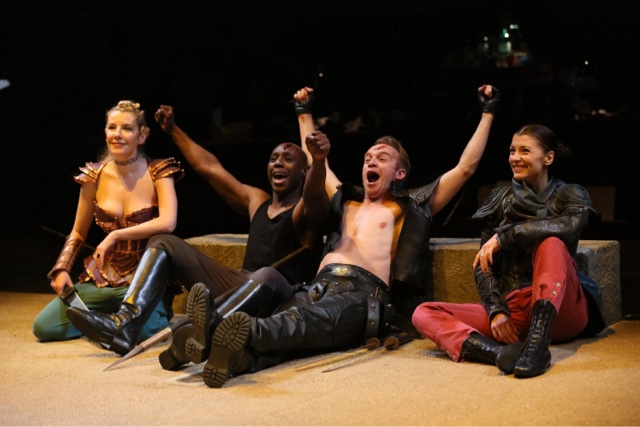
Let’s get one thing out of the way, before I begin my actual review: The Two Noble Kinsmen is not a particularly brilliant, or original, play – it being a curious admixture of intermittent senior Shakespeare and under-pressure junior Fletcher – not part, therefore, of the ‘true’ canon: but staged, here, in celebration of thirty years of my favourite theatre.

As well as its hotchpotch of a ‘plot’ (there will be many such ‘finger-quotes’ – you have been warned…) owing quite a lot to Chaucer’s The Knightes Tale – itself derived from Boccaccio… – and not as well-adapted as you would normally expect from Stratford-upon-Avon’s most famous son – many of its characters (some of whom, in the original text, aren’t even given proper names) appear to have been ‘borrowed’ from a random selection of his other dramas – even if in (light) disguise. [At least there are no girls pretending to be boys, or vice versa: although the play – and the production – is somewhat heartening in its attitude to same-sex relationships and bisexuality (perhaps a reflection of the authors’ own personas…?). It’s just a shame that the same can’t be said for mental illness.]


We’re the middle children of Shakespeare, man. No purpose or place.
For example: Hippolyta and Theseus are directly transposed from A Midsummer Night’s Dream – but I’m not sure I remember them waging war on their neighbours on their way to be wed; nor being in a love triangle with Pirithous, their master of revels (Egeus, by any other name). Additionally, Palamon and Arcite [pronounce Ar‑kite (lemona‑a‑ade!)] appear to be two noble gentlemen ex-pats from Verona – perhaps bringing Emilia with them from Milan on the way. (Her Waiting-Woman, though, is surely Katherine’s Alice, sans accent – “Oui, vraiment” – from Henry V.)

Furthermore, the Jailer’s Daughter is a combination of Ophelia and – yes, of course, there’s a play (of sorts) within a play…! – an initially unwilling member of the Rude Mechanicals [here rudely replaced by unnecessary Country Folk/Morris Dancers: who themselves are probably taken directly from Beaumont’s The Masque of the Inner Temple and Gray’s Inn – and whose leader, (originally) Gerrold (here a Hyacinth Bucket-like Schoolmistress), may well be Holofernes’ cousin…]. After that, I sort of lost count… – if not the plot….

This is not the worst thing that can happen.
I shall instead, therefore, concentrate on the quality (of which there’s quite a lot; and of many differing and opposing kinds) of the RSC’s current production – on until 7 February 2017 (possibly… – although I have never seen the Swan quite this empty: so no wonder they were handing out £10 tickets…). After all, there is no point metaphorically docking a (crucial but metaphorical) star from my rating (as may others) just because the mishmash of a text is not up there with Bill’s best. It’s not like it’s new writing – we’ve known it’s been held together with Jacobean filler for over four hundred years… – so let’s just get over it, and see (like Mrs Lincoln) if I enjoyed the show.


Go ahead, Tysoe, you can cry.
Well, it turns out that the text is the least of the problems: although, you could, if you were being mean, blame all the other flaws on it… – but there are simply far too many; and that would, in reality, be a disingenuous excuse of the lowest order.

Normally, I would argue against performing major surgery on Shakespeare’s words – but the majority, here, are Fletcher’s: and they are not his best (by a long way); nor is the plotting – so, taking your lead from the box-cutter taken to Doctor Faustus, I, personally, would have completely expunged the irrelevant padding of the Jailer’s Daughter subplot – especially as her downward spiral into madness should not be made into something the audience continually and insensitively titters at (was I the only one seething with discomfort and anger…?) – thrown the clodhoppers in a blender; and instead concentrated on the relationship between the two eponymous leads. [Surely we stopped laughing at the mentally ill many, many years ago? I thought the days of paying to see the ‘exhibits’ at Bedlam were long over. (Seems I was wrong.)]

How do I loathe thee? Let me count the ways…. Basically, the production suffers with a bad case of what from now on will be known in these ’ere parts as Cymbelinitis – an inflammation of the importance of appearance and ‘design’ over the strategic and fundamental narrative and directorial arc (caused by giving precedence to tactical gimmickry); resulting in a distension of the play’s temporal existence (that is: it is far too bloody long) and a concomitant shrinkage of the remaining budget; along with a rather blotchy appearance (or ‘rash’). [Are we supposed to be so utterly chuffed at ticking these ‘rarities’ off our list of seen Shakespearean plays (I choose my words carefully) that we’re then required to turn a blind eye to the calibre of the finished article…?]


You’ll wear leather clothes that will last you the rest of your life.
Like her work on the aforesaid disappointment, Anna Fleischle’s design is clunky, and (sometimes literally) all over the place. (It actually looks as if the cast have been told – one at a time; without any regards to, or desire for, consistency or period; or knowing how the others have chosen… – to go into the costume store and simply pick out the outfits they feel they look best in, or have taken a fancy to. And, surprisingly, some of them obviously felt more comfortable still wearing the jeans and Converse trainers they already had on.) It does not help that the overall ‘style’ (ha, bloody ha) is from the school of 1970s Doctor Who – or, indeed, the school of 1970s The Bard of Tysoe: when teenage me was producing and directing the likes of Oliver! with a budget of thruppence-ha’penny; building sets with rolls of wallpaper, volunteers from the sixth-form art and woodworking clubs; and lighting the results with rigs from the 1950s, and bits of melting, coloured plastic. (Many of the costumes came from second-hand shops: to which they were later returned. I’ll let you draw your own parallels….)

It also doesn’t help that the royal court consists of petulant, hormonal, overgrown teenagers: permanently on the verge of either snogging or squabbling; and with about as much authority as an overripe banana (although I thought Chris Jack, as Pirithous, delivered Shakespeare’s description of Arcite’s death – oh, bugger, I’ve spoiled the plot… – with real, intense feeling, and great clarity…).

This farrago of ‘ideas’ – perhaps to match that ‘plot’ (he said, generously) – thus overwhelms our vision, and distracts from (most of) the action: which, of course, does nothing to aid understanding. (In fact, just the opposite.) Having expunged the Prologue – which at least has the decency to say sorry; whilst attempting to warn us that what follows might leave Chaucer rolling in his grave at the way his material has been treated… – the rich-as-treacle, delightful-as-a-diadem language (yes, this bit is undoubtedly Bill) that (now) begins the play doesn’t sink in: because your senses are overloaded with the gallimaufry (no, that is not Doctor Who’s home planet: it’s a polite word for “dog’s breakfast”); and your brain just cannot cope. Sadly, by the time it’s recovered (apologies for the dents on the upright in the Gallery: my head, it seems, is made of sterner stuff…), we’re deep into Fletcher territory.


How much can you know about yourself, if you’ve never been a knight?
Thankfully, Jamie Wilkes (Arcite) and James Corrigan (Palamon) are now on stage: mesmerizing us with their chunky biceps, camaraderie, and top-notch acting (as well as matching clothes – how the heck did that happen…?!) – all whilst clambering around that set like well-trained chimpanzees (sorry, lads). That they manage to pull this off is solely due to their huge matched volumes of talent and charisma. Their swings (cough) from BFFs to mortal enemies and back are beautifully controlled and delivered; and – apart from a couple of notable exceptions – they act the rest of the company offstage. (Perhaps this is wishful thinking…?)

Those “exceptions” are the luminous Danusia Samal as the Jailer’s Daughter – who portrays the loss of her sanity with Natalie Simpson‑levels of empathy, conviction and veracity… – and her gentle, sincere Wooer (the sympathetic Patrick Knowles). Their final scene together is immensely touching: and, to be honest, the only time I was really moved. (There were no shiny golfing bags, or fluttering blue birds, or a singing-ringing tree, to distract… – just love, pure and incredibly complex: “But you shall not hurt me.” “I will not, sweet”. “If you do, love, I’ll cry.”)

When the fight was over, nothing was solved, but nothing mattered.
Other credits must be given to Tim Sutton, for the subtle and alluring score; and Clare-Louise Appleby, Ivor McGregor, Nick Lee, Andrew Stone-Fewings, Kevin Waterman and John Woolf (music director) for bringing it to life with such skill and feeling; and to Kate Waters (fight director), for some extremely convincing swordsmanship and wrestling. Oh, and thank you to Donald Cooper and the RSC Press Office – as always – for the wonderful photographs.


I’m gonna go inside, and I’m gonna get a chainsaw.
Before I go, if anyone can explain Hippolyta’s weapon ‘metaphor’, then I’ll buy them coffee and a bun in The Other Place. Like so much of what passed in front of me – and yes, there was a cuddly toy (a dog, I think – perhaps in reference to the one in A Midsummer Night’s Dream…?) – I will be having vivid flashbacks and nightmares about it for a long time to come. (I may need more therapy.)

[By the way, this is – in the last five years: that is, since I returned to the RSC… – only the second time I haven’t (thoroughly) enjoyed an evening in the Swan.]


Something on your mind, dear?
One last grump, to end on (appositely). Why on earth has Shakespeare’s last sentence – below – been cut? It is so typically his: and therefore beautiful, and laden with meaning. I sat there waiting for it; and, instead, got some berk applauding well before the house-lights went up. I suppose if you’re going to fuck something up, you might as well do it with attitude….

                    O you heavenly charmers,
What things you make of us! For what we lack
We laugh, for what we have are sorry, still
Are children in some kind. Let us be thankful
For that which is, and with you leave dispute
That are above our question. Let’s go off,
And bear us like the time.
– Shakespeare: The Two Noble Kinsmen (V.iv.132-138)

Sunday, 28 August 2016

I’m not just talking about books…


Before I say goodbye to – and (attempt to) let go of – the RSC’s sensational Making Mischief festival (all the photographs of which are by Richard Lakos), there are a few things I need to get off my chest. But first – and I should probably give them their own page: so that I can continually refine them, formalize them, and then link to them… rather than keep on reiterating them – a reminder of the Bardic Principles of Theatre and Art (for want of a better moniker):

I appreciate that many simply go to the theatre to be entertained…. I don’t.
     I go to be challenged. I go to have my mind opened; my heart broken; my soul riven. I go to be educated. I go to weep; to grow – emotionally and psychologically – to laugh; to discover my place in the world that is created in front of me, as well as its relevance to the troubling complexities that exist beyond its literal and figurative bounds. I go to be absorbed into that new interior world; to escape from the old exterior one. I go to be distracted from my constant pain with an injection of a different sort of masochistic agony. I go to retain my sanity. I go to witness and admire deities transform themselves beyond the ken of us mere mortals; to mark miracles. I go to be shocked; to have my opinions and beliefs confirmed, or challenged and transformed; to see and hear and feel things that I have never seen and heard and felt before. And may never see and hear and feel again. I go because it is incredible, unreal: but also because I know I will still believe. I go because I know that, each and every time, I will emerge transformed. In other words, I go to connect to everything I am not; to have my life enriched. I go because it is Art; because Art is humankind’s greatest invention; its saving grace; its redemption; and because it speaks to me so directly, as only Art can. I also go, because, to be blunt, it is so bloody awesome!
     And if I hadn’t gone, I wouldn’t have experienced some of the greatest plays ever written, performed by some of the greatest actors ever born…. And my life would be so much poorer for that lack; and I would not know that, in the blackest depths of my despair, there could be – there was – salvation. So I will – I must – continue to go: to discover yet more reasons for going. And – of course – to be entertained…!

I would like to supplement this with some words (“yet more reasons for going”) shared yesterday – before the final shows of Always Orange and Fall of the Kingdom, Rise of the Foot Soldier – by Laura Howard (who is (wonderful) in both plays):

When we create or appreciate art, we set free the spirit trapped within. That is why art arouses such joy. Art – whether skilfully executed or not – is the emotion, the pleasure of expressing life as it is. Those who see art are moved by its passion and strength, its intensity and beauty. That is why it is impossible to separate life from art. Political and economic developments may seem to dominate the new, but culture and education are the forces that actually shape an age, since they transform the human heart.
– Daisaku Ikeda: Wisdom for Modern Life (27 August 2016)

I may not agree with everything stated here: especially the words “joy”, “pleasure” and “beauty” (I think their antonyms are equally valid; and perhaps crucial…). And I do not, for one moment, expect everyone who sees art to be moved by it (see above). But I do concur with the general proposition.


When I wrote my original “principles” – almost a manifesto – I was discussing “theatre as therapy”: because of my current war with depression and PTSD (which I am beginning to win, one tailgating truce at a time…). And I felt ‘safe’ in doing so: because I am undergoing formal treatment. However, it occurred to me on Wednesday, at my second viewing of Always Orange, that the play itself contains several ‘trauma triggers’ – although I accept that these are so specific that there will be very few people watching that might be affected by them. This is not to say, though, that those, such as myself, who suffer from PTSD with other origins – but who aren’t being treated – won’t be similarly disturbed.

This is from my original review:

I described Always Orange as “devastating… important and necessary theatre”…. Having written twice, recently… about “theatre as therapy”, this was probably the toughest (but most rewarding) of the three plays to sit through, for me: its depiction of post‑traumatic memory searingly (and, in my case, tear-jerkingly, shoulder-shudderingly) accurate – and perfectly portrayed by the mesmerizing Ifan Meredith, as Joe (“a British man”).

Having seen audience members turn a funny colour when Gloucester’s eyes are gouged out; yet laugh at the decapitation of Cloten – an act that would seem horribly contemporary… – it is obviously impossible to predict how people will react. I myself tittered at the warning sign outside King Lear, at the Royal Theatre in Northampton – “During this performance there will be: Smoke, Gun Shots, Smoking, Flashing Lights, Strobes, Loud Bangs” – because of the absence of any mention of the frequent violence, and the resultant copious amounts of blood that are spilled. And yet, if there is one Shakespeare play that I would not venture near, it is Titus Andronicus…! (But I say this, of course, having been forewarned by both reading the text, and by others’ experiences.)


Before you have a go at me for being over-sensitive – although this is surely a state we all want to be in, if we’re going to be moved to the max…? – I’m not demanding EastEnders‑type “If you have been affected by issues…” paragraphs printed in red ink on the front covers of programmes; nor for leaflets for the Samaritans to be handed out at every show. (I do know that this would be impractical. Mebbe.)

What I am asking – as an extension of considering the physically disabled, when designing access policies – is that we consider how the power of theatre affects individuals – especially those with mental health problems – in different ways: hoping that, firstly (and accepting that there is a suspension of disbelief for many), well-directed and -produced drama will, in most cases, be beneficial in some way. Secondly, though – where theatre deliberately sets out to provoke: as the four plays that made up Making Mischief so successfully did… – we (both creators and consumers) need to be prepared for those provocations to not only upset (which, surely, is one of the many duties of art: “I go to be challenged…”); but, occasionally, cross some sort of personal boundary. And we need to be ready to make allowances; deal with the consequences; and accept responsibility (not that there are – or should be – easy answers…).


The crux of this issue is probably hidden somewhere in the mix of how we are affected (where those “personal boundaries” lie; what experiences we bring with us; and our general sensitivities); the motivation behind the challenge itself (is this a wake-up call; are our beliefs being teased or taunted; or are we deliberately being insulted and/or offended…?); and the context (which is why relaxed performances are such a wonderful thing…). It is therefore a tricky balance to achieve: especially if one wants to (as one should) instigate change (via drama) – and especially when so many people are resistant to it; and only see and hear what they want to.

To my way of thinking: even with such considerations, there are risks that are worth taking – otherwise theatre (as a subset of art) becomes diluted and ineffectual. I would rather be shaken to my core (physically, mentally, emotionally – even in my current, relatively-fragile state), than bored: “I appreciate that many simply go to the theatre to be entertained…. I don’t.” And, yes, this can be achieved with texts that are centuries old: whether reinterpreted through the eyes of a contemporary director; or revised by the pen of a modern playwright. Otherwise, the works of Shakespeare, Marlowe and Jonson; Aeschylus, Sophocles and Aristophanes – although simply reading their words can be transformative – would have been tossed in the bin years ago.


Thanks to the wonderful access policies of the RSC (especially the saintly Jim Morris), I had a reserved seat front and centre for the last performance of Always Orange. I could blame it on the captions at the first viewing; or trying to see through tears at the second; but, this time, everything clicked: as if some sort of automated “aleatoric” jigsaw had finally completed itself in my head with a resounding – yet whispered – “Bang”. (Knowing I would not see it again, perhaps, additionally, my concentration was dialled up even further than normal?)


This is, I think, a ‘writerly’ play – Fraser Grace’s words are “of the highest quality and laser-guided precision (the prologue reads as poetry; yet the craft is invisible)” – almost certainly, if I had the talent, the kind I would like to author. But I wonder if this ‘precision writing’ is at the root of some people’s emotional disconnection with it…? (Ignoring the cardboard boxes – perhaps – and any other ‘Faustian’ parallels – there is a quality to the text that, for me, recalls Marlowe: especially the rapid “tragicomic” contrasts of tongue-in-cheek and transcendent; as well as the intrinsic lyricism and power.)

I admit that (as detailed above), Joe’s scrambled memory and resultant actions speak to, connect with, me with heart-piercing accuracy. I am Joe. The flying metal that shredded my mind (“I’m a mist now”); the paper cuts that flailed my skin; the thunderous collision of books and stage… all too close for comfort. But, if I am the only person (which I don’t for one moment believe…) that sees through and past the wordplay, the surface jokes, the thudding visual metaphors; who is then ‘spoken to’ loudly and clearly… – a bloody immersion in belief; rather than a dismissal of doubt – well, is that how you measure a play’s success (at least on the individual, micro level…)? Or maybe it is just one of those dramas – like Cymbeline, “actually a damnably good read” – that just works better on the page?

Just not for me. This was truth writ in blazing, large capital letters. It hurt like hell – especially when Joe bellowed “I don’t remember anything.” But there is always comfort in understanding: whether it is your own; or someone-else’s shared vantage point and sympathy.


There is a risk, of course, that, in also weeping all the way through Fall of the Kingdom, Rise of the Foot Soldier (and for the fourth time), I was only following the same well-trodden path of “middle-class tolerance” as represented by “good person” Hawkins. And yet my belief (my personal reading; taking all the above into account) is that everyone’s perspective (moulded by nature and nurture) carries some form of validity – even if we violently disagree with it. The problem lies in actually establishing equality… – of perspective; of achievement; of entitlement; of opportunity… – although my emphasis here (from the viewpoint of a middle-aged, working-class, well-educated deaf and disabled man, with ethnicity running through his extended family like a rich vein of gold) may be different from yours. “This is our England.” YMMV, as they say.

But that is where the potency of this play – as it is performed here – lies. The actors in the principal roles (apart from Ifan Meredith as Archie, I would guess) could all be seen to have sympathy (if not empathy) with those they represent. The actors playing the Chorus, definitely not. This dichotomy – “the deep wound of cultural tension cutting through modern England” – for me (“from the viewpoint”, etc.) fuels its impact: propelling the already powerful script – again laced with poetry – into the political stratosphere. However, for others watching, I can accept that they may only see their personal prejudices – whether similar or different to mine – reinforced.


In a nutshell… this is why we need art that forces us to question ourselves. (That’s why “I was glad, though, that I saw [Revolt. She Said. Revolt Again.] twice on the same day”.) If you’re not willing to face those inner demons (not necessarily face them down…), then just go and be “entertained”. That’s fine. But I worry that you’re missing something, missing out on something, in doing so….


Postscript…
I found a shred of paper – a shard from “the sea of glass” – trapped in my copy of the text of Always Orange. “I’m very collected. Thankyou.” But I wasn’t… – not for some time. “I remembered something, from before.”

Thursday, 18 August 2016

Tin or aluminium; not titanium…


It was the best of times, it was the worst of times, it was the age of wisdom, it was the age of foolishness, it was the epoch of belief, it was the epoch of incredulity, it was the season of Light, it was the season of Darkness, it was the spring of hope, it was the winter of despair, we had everything before us, we had nothing before us, we were all going direct to Heaven, we were all going direct the other way – in short, the period was so far like the present period, that some of its noisiest authorities insisted on its being received, for good or for evil, in the superlative degree of comparison only.
– Charles Dickens: A Tale of Two Cities

Yesterday (Wednesday) was a birthday of sorts… – not the anniversary of my coming into this world (that’s in a week or so – hint, hint); but of me being given my life back, thoughtfully and carefully, and by a very special human being indeed: who has, with his family, also had to endure some very tough challenges. But, for many reasons – although I am immensely and eternally grateful for that great man’s incredible skill and deep compassion; and have been so every single day for the last ten years – it was not an occasion I had been looking forward to.


The circumstances prompting such dejection include a deterioration of my physical health that those who know me will have seen or suspected. And those with a brain (and, yes, if you peruse the images on this page, you will notice that I also possess one…) will have quickly grasped this decline’s bitter, but inseparable, relationship with the struggle I am currently undergoing with my mental wellbeing. What no‑one could have known – because, despite my suspicions, I was only finally brave enough to put myself through my umpteenth MRI scan a few weeks ago… – is that both of these downturns stem from marked physiological changes all too similar to those I endured in the years before (and which prompted) the complex operation that, a decade ago, vastly improved my quality of being (and continues so to do).

As I said to my current neurologist:

Although the experience was actually quite painless – I was discharged thirty-six hours after admission in a much, much better state than I had entered the hospital: having [reclaimed] the use of my left arm and hand (which was now full of sensation again); regained some movement in my neck; and didn’t walk like a drunken penguin – it is the associated risks I do not like. Nor do I enjoy the thought of this having to be repeated over and over again.

[Technically – for those who may be interested in such things – the procedure was a dual-level anterior cervical discectomy and fusion at C5/6 and C6/7. In other words, I have a metal plate screwed into the front of three of my vertebrae: which holds my head on to my body. (Yes, this makes me Steve Austin! Yippee!) Most of the time, though, I forget all that scaffolding is there. However, without fail, every anniversary, my neck feels more bulky; somehow inflamed and heavy… – even though, of course, nothing has really changed; and the implanted alien structure is truly featherweight.]


All last week, we had an orphaned great tit – several times each day, regular as nature’s clockwork – try to enter the house through the same closed windows. It seemed so determined; and would cling to the frames, pecking at the panes, with all its might: not perturbed even when face-to-face with us scary, ginormous humans. It obviously knew the glass was there (although may well have imagined itself duelling with a mirror-image protagonist); and appeared to suffer no harm, physically, when constantly thwarted. It was also growing rapidly: quickly evolving from fluffy rotundity to sleek, smooth adulthood. I was therefore not overly-concerned for its wellbeing.

I sensed loneliness, though. Unlike the many young blackbirds, thrushes, finches, sparrows, dunnocks, robins and wrens who similarly perch on our back garden fence; cling to the feeders; or scrabble amongst the flowers, shrubs and vegetable patch for insects, worms and snails; this one’s long streams of repeated single tweets evoked no parental response; nor did it, to my knowledge, congregate with the many others of its kind – the flocks of further great, blue and coal tits that often visit (although which are now to be found feasting in the freshly-harvested fields… – hopefully now joined by my absent visitor).

I also perceived – probably because I was feeling it myself… – a great deal of frustration. I know I shouldn’t really anthropomorphize – although where would we be without the wonderful Watership Down and The Wind in the Willows…? – but I felt its pain; and now miss its recurring calls. It had become my daemon; and was, I suppose, a manifestation of what I was – and still am – going through.


Of course – as those few loyal readers of this blog will have anticipated – my response to all of this has precipitated more insomniac wanderings through the benighted village. For instance, early last week, stricken with vertigo, I lay on one of the benches in the churchyard, swaddled in my unseasonal body- and neck-warmers, my legs over the armrest, staring directly upwards: revelling for an hour in the bells’ quarterly chimes, as my eyes grew slowly accustomed to the darkness; praying for Perseids. But it was too soon: and I saw only one such meteor – although that was utterly breathtaking. I was, however, rewarded with the sight of a trillion individually-polished gems: some of them lining up to form the impressionistic backbone of the Milky Way. It was thus hard to drag myself away – even though my body had melded painfully with the rigid woodwork. Unfortunately, the rest of my wanderings, that week, were under gathered clouds: with only rare glimpses of what lay above; of what I sought.

Yet, this Tuesday night, lit by an almost full moon – and with even the Plough struggling to make its presence known against such radiance – I felt truly at peace: my long, accompanying shadow a reminder of the miracles that our planet’s journey through the firmament can produce; rendering the church tower a glowing bastion; the golden hands of its clock easily legible; as were the familiar names etched into the headstones. I could have limped all the way to Kineton: such was the energy I was imbued with.


But yesterday, the (inner) gloom returned: reminding me that troublesome decisions have to be made; that I may have to carry out a pilgrimage to my original saviour; that – just as I find a way of life that is approximately practicable, and completely fulfilling, as well as within the limits of my disability – I may have to put everything on hold once more; or attempt to adapt, yet again, to another step-change in infirmity. I honestly feel as if I am that small bird, endlessly pecking away at the indestructible….

But that’s all in the future. Now, it’s just time to pull my boots on, and head out into the night again: acknowledging that there are far too many people in much, much worse situations. If nothing else, being enveloped by the moon’s cooling light is a great reminder of my position in the universe; and of the beauty that completely surrounds us.


Sunday, 24 July 2016

Fizzy deadly nightshade cordial…


Listen, don’t mention Christopher Marlowe! I mentioned him once, but I think I got away with it all right…. So! It’s all forgotten now, and let’s hear no more about it. So, that’s two grated Tamburlaines, a Jew of Malta, a Doctor Faustus, and four Dido salads.

I suppose with a title like Mrs Shakespeare, a show like this was bound to attract Will (and Chris (and Ben)) aficionados (like me!) – so why only a dozen or so in the audience at The Bear Pit? Were the rest “i’ th’ other place” – or simply (this being the first Saturday night of the summer holidays) filling Stratford-upon-Avon’s many eateries: consuming “the food of love” (or just stuck on a motorway “In congregations, to yawn, be still, and wonder”…)? Whatever the answer, those poor souls (assuming they hadn’t seen it earlier in the week) missed out on an hour of intelligently hilarious, devastatingly tragic, powerfully insightful, full-on, perfectly-presented, multi-layered drama – not only theatre as entertainment; but, again – for me, at least – theatre as therapy. [And, rather cunningly, (failing) therapy as (successful) theatre.]

I make no apologies, therefore, for quoting a huge chunk of the Doctor Faustus review that precedes this (and which you will also find if you click that link, directly above) – as it applies fully, here, as well:

I go to be challenged. I go to have my mind opened; my heart broken; my soul riven. I go to be educated. I go to weep; to grow – emotionally and psychologically – to laugh; to discover my place in the world that is created in front of me, as well as its relevance to the troubling complexities that exist beyond its literal and figurative bounds. I go to be absorbed into that new interior world; to escape from the old exterior one. I go to be distracted from my constant pain with an injection of a different sort of masochistic agony. I go to retain my sanity. I go to witness and admire deities transform themselves beyond the ken of us mere mortals; to mark miracles. I go to be shocked; to have my opinions and beliefs confirmed, or challenged and transformed; to see and hear and feel things that I have never seen and heard and felt before. And may never see and hear and feel again. I go because it is incredible, unreal: but also because I know I will still believe. I go because I know that, each and every time, I will emerge transformed. In other words, I go to connect to everything I am not; to have my life enriched. I go because it is Art; because Art is humankind’s greatest invention; its saving grace; its redemption; and because it speaks to me so directly, as only Art can. I also go, because, to be blunt, it is so bloody awesome!


In a way, the title of this post – a device from the play itself – sums up the contents of the evening quite neatly. I have a feeling, though – backed up by Google’s statistics (if anyone mentions “damned lies”, they can leave now…) – that people don’t come here for pithy four-word reviews. (Or, if they do, they are bound to be sorely perturbed and disappointed… – and frequently by a factor of several hundred.)

The almost unbelievably versatile Irene Kelleher, as the eponymous Mrs Shakespeare (yup, she really was christened ‘William’ by the Bard-fixated parents who we are led to believe drove her to her current dire straits) is as energetic and fizzy as Puck (if you’re reading this aloud to someone, please be careful…) – at once petite and vulnerable as Ophelia; the next moment – with just the closing of a Freudian eye – authoritative and menacing as Oberon; sometimes as quick and quirky as Touchstone; or as opinionated and simperingly long-winded as Polonius – just one of the many voices she hears internally, and proclaims with pitch-perfect gusto. (One could, indeed, say that she is one of “The best actors in the world, either for tragedy, comedy, history, pastoral, pastoral-comical, historical-pastoral, tragical-historical, tragical-comical-historical-pastoral scene individable, or poem unlimited…”; and without exaggeration: not only for bundling all these into one too-short hour – in which she really does visibly age and gradually mentally unwind – but particularly as she continually juggles this variety simultaneously and successfully – unlike the poor bouncing Yoricks.) [At last! I’ve found a name for my touring theatre company! Yay!]

Her shouts (and whispers) of “Who am I?” – are they Ophelia’s; or are they her’s…? – though, are as traumatic and piercing as Lear’s mournful “Who is it that can tell me who I am?” – especially when she locks her glistening eyes on yours, and just won’t let go. (Gosh: this is brave stuff. Are you staring into her heart; or is she – more likely – interrogating yours…?) The expanding, expansive repetition of that question at so many pitches, and with such a devastating mix of emotions, thus becomes as soul-rending as his “Never, never, never, never, never.” (This is possibly the most difficult line in the Shakespeare canon to deliver – but I have a feeling that Kelleher, with her magnificently huge range of physical and vocal talents, would dissolve us all instantly to grief-stricken puddles with her rendition.)


I don’t know if it helped that I saw the RSC’s current nigh-on-perfect production of Hamlet for the third time on Thursday; or that I now know, from personal experience, so damned much about mental health (or its lack). All I can say for certain (but, probably from your perspective, with intense subjectivity) is that writer and director Ian Wild grabs both by the scruff – the ruff?! – of their necks, whilst wearing his knowledge lightly; bangs their heads together (sometimes quite violently – the oft-cartoonish nature not reducing the impact one iota); and emerges with something incredibly bruising, but immensely entertaining (as funny as Titus Andronicus, yet as tragic as The Merry Wives of Windsor…). There is a mass of intelligence bubbling beneath the surface of this script; as well as a plethora of what might be raw and open psychological wounds.

It is hard to imagine that Wild hasn’t experienced some of these issues himself. But, of course, he could just be a brilliant researcher; and the world’s best transformer of third-party information into gob-smackingly potent drama. I really don’t know. (And it really doesn’t matter.) All that counts, and all that I am conscious of, is that – with Kelleher’s mesmerizing, all-guns-blazing delivery – he hits his multiple targets over and over again with profound accuracy. Who knew that dissociative identity disorder could be so much fun (and yet without once insulting its sufferers – in fact, showing a keen comprehension of their plights, as well as unadulterated empathy)? Of course there’s an “up the arras” joke… – but the belly-laughs this provokes only underlines the agony of delusion, the pain of psychosis, with its acute antithesis.


The pacing of the play – and Kelleher’s transformation from someone to laugh at, then laugh with; to someone you sympathize with; identify with; want to rescue (knowing you can’t – these are her demons…); feel pity for (as well as feeling anger at the ‘treatment’ that fails her – a system you know is all too real…) – is perfection itself. That you leave with more questions than answers – whilst weighed down with jollity, if you will – is a demonstration of its energy and brutal, subtly-crescendoing effectiveness. As I’ve probably said many times before (as have, I am sure, so many others): comedy isn’t funny without a continual thread of adversity; and tragedy isn’t sad without the stout opposition of humour. (We left Hamlet, on Thursday afternoon, dabbing away the weeping that Horatio’s howls at Hamlet’s death had provoked. And yet the frequent tears of laughter had been, in many ways, just as scalding.)


I wish I had seen this earlier. It has the authority of a modern parable. And I am sure I would therefore have returned again and again. (Yes – however different – it has the potential, I feel, to be just as addictive – for me, anyhow – as nine-times-viewed Faustus.) It just shows what dramatic power can be achieved with minimal – but massively effective – props (the cunning set is by Davy Dummigan and Dowtcha Puppets); and an ingenious, insightful script – especially when delivered by a single, enthralling, multi-gifted actor.

From the play’s Facebook page, it would appear that it tours frequently – indeed, this is its second visit to Shakespearetown… – so it’s probably worth keeping an eye out for (cue Duke of Gloucester joke), if I haven’t, somehow, put you off. Seriously, it is incredibly funny. And vice versa. I really can’t recommend it highly enough. Honestly. It is that good. (Only more so.)

Tuesday, 12 July 2016

Just when you thought it was safe to go back in the slaughter…

Please note…
The following review (if that’s what it is) discusses aspects of mental illness – albeit from my limited, yet intimate, exposure. It also contains far too many emphasized, italicized words and phrases; and some fabulous photographs by Helen Maybanks, courtesy of the RSC.


I am such a slow learner…. Although I have now seen the extraordinary RSC staging of Doctor Faustus eight times – and I have written before about why I thought I was so hooked (and not just because of its towering achievement and merit; and in all quarters): Only the darkness would remain: hence, perhaps, the addiction to… an unremitting nightmare way beyond hope: and which, to me, currently feels all too real… – it was a remark made by Oliver Ryan, at last night’s post-show Q&A, which finally pinned down its incontrovertible, particular (to me) compulsion. [This post is therefore dedicated, with both respect and gratitude, to Ryan; along with an acknowledgement that his insight led to it being written in the first place!]

He talked – and it felt as if it was from personal experience: although he is very widely read; with a deeply intelligent and enquiring attitude to the world around him… – about how one would even “run into a brick wall” in an attempt to stop an onslaught of anxiety: “you would do anything…”. There were additional references from other members of the company – including assistant director Josh Roche – to mental illness: especially depression (and its sometime manifestation as those pernicious panic attacks) and schizophrenia. [This is, after all, a drama where a pair of perfectly-matched actors play two interchangeable, twisted, warped-mirror aspects of the same dissevered soul; where we ourselves cannot distinguish reality, or if the action – and therefore hell – is all in Faustus’ imagination (or “discovered in his study”); and where delusion, introversion and dissociation are therefore omnipresent.]

All sin tends to be addictive, and the terminal point of addiction is what is called damnation.
– WH Auden: A Certain World

I thought, at first, that my obsession stemmed from the self-serving schadenfreude (an eighth deadly sin?) one succumbs to (instead of pity) when watching someone else literally go through perdition – combined with distraction, by way of complete captivation: ’Tis magic, magic that hath ravish’d me… – and, in a way, I was right. But I had also assumed, consequently, that it was the relief (a sort of dramaturgical intoxication) that emanated from such an experience which was at the root of my preoccupation. And I was wrong.


Having attended (and then helped deliver) a pain management course, fifteen or so years ago (which, in a way, emulated group therapy: there are many parallels with my current one-on-one CBT sessions), I should be (more) aware that it is the precious comradeship which develops amongst people with similar plights that is paramount. This not only creates a starting-point leading to those comrades coping better with their own suffering; but also gives them sorely-needed perspective. (In other words, there is legitimacy at the core of the two saws that “a problem shared is a problem halved”; and “there is always someone who is worse off than you” – not that the latter always bring comfort.)

What I’m trying to get at is that empathy – not sympathy – is crucial, here. And not only does this production (building on the miraculously equivocal text) refuse to judge Faustus in any way (or doppelgänger Mephistophilis) – each individual audience member having to draw their own conclusions (should they wish to) – it actually demonstrates (from my individual vantage point) an understanding of Faustus’ motives: even though (he may believe) he has only himself to blame – both for the predicament he is in; and his inability to fully commit to it. Such culpability fuels the resultant doubt and regret that become exponentially more substantial – as Marlowe’s poetry grows in intensity – the closer midnight approaches. But – from my experience and research (including a twenty-five page essay for my therapist on the post-traumatic stress disorder (PTSD) that has caused my slippery struggle with depression to slither from my grasp) – such conviction in your own failings, your own liability, comes with the territory.

In other words, each viewing is, for me, a form of therapy.


As with schizophrenia – which may be confused with, or uninformed shorthand for, dissociative identity disorder (DID) – therapy, as a word, I think, is easily misinterpreted: in this case, as (treatment leading to) a conclusive cure. However, in actuality – particularly with regards to mental illness – therapy is an ongoing, possibly never-ending, process (unlike this theatrical run). And, although it should lead to improvement, it is unlikely to be a complete emendation. [This misapprehension is equivalent to a statement that “I am better” resulting in the addressee – probably from a lack of knowledge of the complexities of my disability – inferring that I am wholly recovered; or have been mended, restored to full health. (Physiologically and neurologically, this is impossible.) Yet what I am trying to impart is that I am – however one would wish to quantify it – just having a good day (or, typically, some much smaller portion of time – perhaps the length of a good play, or concert…).]

Additionally: therapy does not happen in discrete ‘chunks’; nor is it passive – for either therapist or patient. (Nor does it involve me reclining on a chaise-longue!) In fact, it is bloody hard work; and can be extremely distressing. [In Faustian terms, you (will probably, at some stage) have to confront your demons. Mine, however, do not look like a cross between Charlie Chaplin and a droog: rather, they arrive all too swiftly on four wheels….]

People who are willing to do assignments at home seem to get the most benefit from CBT. For example, many people with depression say they don’t want to take on social or work activities until they are feeling better. CBT may introduce them to an alternative viewpoint – that trying some activity of this kind, however small-scale to begin with, will help them feel better.


Unlike the above truisms, I am of the opinion that Nietzsche was talking out of his Unzeitgemässe Betrachtungen when he said (or more likely wrote) “That which does not kill us, makes us stronger”. It may apply to some – but not me; and not many that I know of who have also experienced serious disruptions to their lives (somewhat ironically including the man himself).

Doctor Faustus, though – and it has just occurred to me that the clue is in his title… – has vastly improved my quality of life with each visit (too simple a word, really for what I described in my original review as “the [utterly remarkable] very definition of theatre”). In between whiles, the ensuing penning of critiques and necessary accompanying self-interrogation (“assignments”, if you will) have helped enlarge the drama’s therapeutic – in my dictionary, an adjective aptly “relating to the healing arts” – potency. (That which thrills us, makes us stronger.)

I appreciate that many simply go to the theatre to be entertained; or [snobbery alert!] to vaunt the intellectual prowess that is evidenced by managing – just the once, Mrs Wembley – to sit through three hours of Shakespeare, or seventeen of Wagner (even if they arrived ten minutes late for their mid-row seats; drifted off occasionally; coughed and whispered in all the quiet bits; increasingly gazed at their watches in despair; fanned and/or dropped their programmes; rustled in their handbags for sweets; fired off a few Tweets; applauded, or worse, joined in with, a famous quotation, mid-soliloquy; nipped out to the loo; or appeared to be attempting several different yoga positions per scene…). I don’t.

I go to be challenged. I go to have my mind opened; my heart broken; my soul riven. I go to be educated. I go to weep; to grow – emotionally and psychologically – to laugh; to discover my place in the world that is created in front of me, as well as its relevance to the troubling complexities that exist beyond its literal and figurative bounds. I go to be absorbed into that new interior world; to escape from the old exterior one. I go to be distracted from my constant pain with an injection of a different sort of masochistic agony. I go to retain my sanity. I go to witness and admire deities transform themselves beyond the ken of us mere mortals; to mark miracles. I go to be shocked; to have my opinions and beliefs confirmed, or challenged and transformed; to see and hear and feel things that I have never seen and heard and felt before. And may never see and hear and feel again. I go because it is incredible, unreal: but also because I know I will still believe. I go because I know that, each and every time, I will emerge transformed. In other words, I go to connect to everything I am not; to have my life enriched. I go because it is Art; because Art is humankind’s greatest invention; its saving grace; its redemption; and because it speaks to me so directly, as only Art can. I also go, because, to be blunt, it is so bloody awesome!

And if I hadn’t gone, I wouldn’t have experienced some of the greatest plays ever written, performed by some of the greatest actors ever born – the pinnacle of which, of course, is Doctor Faustus, about to end its long run in one of the greatest theatres I know. And my life would be so much poorer for that lack; and I would not know that, in the blackest depths of my despair, there could be – there was – salvation. So I will – I must – continue to go: to discover yet more reasons for going. And – of course – to be entertained…!