Showing posts with label The Other Place. Show all posts

Sunday, 28 August 2016

I’m not just talking about books…


Before I say goodbye to – and (attempt to) let go of – the RSC’s sensational Making Mischief festival (all the photographs of which are by Richard Lakos), there are a few things I need to get off my chest. But first – and I should probably give them their own page: so that I can continually refine them, formalize them, and then link to them… rather than keep on reiterating them – a reminder of the Bardic Principles of Theatre and Art (for want of a better moniker):

I appreciate that many simply go to the theatre to be entertained…. I don’t.
     I go to be challenged. I go to have my mind opened; my heart broken; my soul riven. I go to be educated. I go to weep; to grow – emotionally and psychologically – to laugh; to discover my place in the world that is created in front of me, as well as its relevance to the troubling complexities that exist beyond its literal and figurative bounds. I go to be absorbed into that new interior world; to escape from the old exterior one. I go to be distracted from my constant pain with an injection of a different sort of masochistic agony. I go to retain my sanity. I go to witness and admire deities transform themselves beyond the ken of us mere mortals; to mark miracles. I go to be shocked; to have my opinions and beliefs confirmed, or challenged and transformed; to see and hear and feel things that I have never seen and heard and felt before. And may never see and hear and feel again. I go because it is incredible, unreal: but also because I know I will still believe. I go because I know that, each and every time, I will emerge transformed. In other words, I go to connect to everything I am not; to have my life enriched. I go because it is Art; because Art is humankind’s greatest invention; its saving grace; its redemption; and because it speaks to me so directly, as only Art can. I also go, because, to be blunt, it is so bloody awesome!
     And if I hadn’t gone, I wouldn’t have experienced some of the greatest plays ever written, performed by some of the greatest actors ever born…. And my life would be so much poorer for that lack; and I would not know that, in the blackest depths of my despair, there could be – there was – salvation. So I will – I must – continue to go: to discover yet more reasons for going. And – of course – to be entertained…!

I would like to supplement this with some words (“yet more reasons for going”) shared yesterday – before the final shows of Always Orange and Fall of the Kingdom, Rise of the Foot Soldier – by Laura Howard (who is (wonderful) in both plays):

When we create or appreciate art, we set free the spirit trapped within. That is why art arouses such joy. Art – whether skilfully executed or not – is the emotion, the pleasure of expressing life as it is. Those who see art are moved by its passion and strength, its intensity and beauty. That is why it is impossible to separate life from art. Political and economic developments may seem to dominate the new, but culture and education are the forces that actually shape an age, since they transform the human heart.
– Daisaku Ikeda: Wisdom for Modern Life (27 August 2016)

I may not agree with everything stated here: especially the words “joy”, “pleasure” and “beauty” (I think their antonyms are equally valid; and perhaps crucial…). And I do not, for one moment, expect everyone who sees art to be moved by it (see above). But I do concur with the general proposition.


When I wrote my original “principles” – almost a manifesto – I was discussing “theatre as therapy”: because of my current war with depression and PTSD (which I am beginning to win, one tailgating truce at a time…). And I felt ‘safe’ in doing so: because I am undergoing formal treatment. However, it occurred to me on Wednesday, at my second viewing of Always Orange, that the play itself contains several ‘trauma triggers’ – although I accept that these are so specific that there will be very few people watching that might be affected by them. This is not to say, though, that those, such as myself, who suffer from PTSD with other origins – but who aren’t being treated – won’t be similarly disturbed.

This is from my original review:

I described Always Orange as “devastating… important and necessary theatre”…. Having written twice, recently… about “theatre as therapy”, this was probably the toughest (but most rewarding) of the three plays to sit through, for me: its depiction of post‑traumatic memory searingly (and, in my case, tear-jerkingly, shoulder-shudderingly) accurate – and perfectly portrayed by the mesmerizing Ifan Meredith, as Joe (“a British man”).

Having seen audience members turn a funny colour when Gloucester’s eyes are gouged out; yet laugh at the decapitation of Cloten – an act that would seem horribly contemporary… – it is obviously impossible to predict how people will react. I myself tittered at the warning sign outside King Lear, at the Royal Theatre in Northampton – “During this performance there will be: Smoke, Gun Shots, Smoking, Flashing Lights, Strobes, Loud Bangs” – because of the absence of any mention of the frequent violence, and the resultant copious amounts of blood that are spilled. And yet, if there is one Shakespeare play that I would not venture near, it is Titus Andronicus…! (But I say this, of course, having been forewarned by both reading the text, and by others’ experiences.)


Before you have a go at me for being over-sensitive – although this is surely a state we all want to be in, if we’re going to be moved to the max…? – I’m not demanding EastEnders‑type “If you have been affected by issues…” paragraphs printed in red ink on the front covers of programmes; nor for leaflets for the Samaritans to be handed out at every show. (I do know that this would be impractical. Mebbe.)

What I am asking – as an extension of considering the physically disabled, when designing access policies – is that we consider how the power of theatre affects individuals – especially those with mental health problems – in different ways: hoping that, firstly (and accepting that there is a suspension of disbelief for many), well-directed and -produced drama will, in most cases, be beneficial in some way. Secondly, though – where theatre deliberately sets out to provoke: as the four plays that made up Making Mischief so successfully did… – we (both creators and consumers) need to be prepared for those provocations to not only upset (which, surely, is one of the many duties of art: “I go to be challenged…”); but, occasionally, cross some sort of personal boundary. And we need to be ready to make allowances; deal with the consequences; and accept responsibility (not that there are – or should be – easy answers…).


The crux of this issue is probably hidden somewhere in the mix of how we are affected (where those “personal boundaries” lie; what experiences we bring with us; and our general sensitivities); the motivation behind the challenge itself (is this a wake-up call; are our beliefs being teased or taunted; or are we deliberately being insulted and/or offended…?); and the context (which is why relaxed performances are such a wonderful thing…). It is therefore a tricky balance to achieve: especially if one wants to (as one should) instigate change (via drama) – and especially when so many people are resistant to it; and only see and hear what they want to.

To my way of thinking: even with such considerations, there are risks that are worth taking – otherwise theatre (as a subset of art) becomes diluted and ineffectual. I would rather be shaken to my core (physically, mentally, emotionally – even in my current, relatively-fragile state), than bored: “I appreciate that many simply go to the theatre to be entertained…. I don’t.” And, yes, this can be achieved with texts that are centuries old: whether reinterpreted through the eyes of a contemporary director; or revised by the pen of a modern playwright. Otherwise, the works of Shakespeare, Marlowe and Jonson; Aeschylus, Sophocles and Aristophanes – although simply reading their words can be transformative – would have been tossed in the bin years ago.


Thanks to the wonderful access policies of the RSC (especially the saintly Jim Morris), I had a reserved seat front and centre for the last performance of Always Orange. I could blame it on the captions at the first viewing; or trying to see through tears at the second; but, this time, everything clicked: as if some sort of automated “aleatoric” jigsaw had finally completed itself in my head with a resounding – yet whispered – “Bang”. (Knowing I would not see it again, perhaps, additionally, my concentration was dialled up even further than normal?)


This is, I think, a ‘writerly’ play – Fraser Grace’s words are “of the highest quality and laser-guided precision (the prologue reads as poetry; yet the craft is invisible)” – almost certainly, if I had the talent, the kind I would like to author. But I wonder if this ‘precision writing’ is at the root of some people’s emotional disconnection with it…? (Ignoring the cardboard boxes – perhaps – and any other ‘Faustian’ parallels – there is a quality to the text that, for me, recalls Marlowe: especially the rapid “tragicomic” contrasts of tongue-in-cheek and transcendent; as well as the intrinsic lyricism and power.)

I admit that (as detailed above), Joe’s scrambled memory and resultant actions speak to, connect with, me with heart-piercing accuracy. I am Joe. The flying metal that shredded my mind (“I’m a mist now”); the paper cuts that flailed my skin; the thunderous collision of books and stage… all too close for comfort. But, if I am the only person (which I don’t for one moment believe…) that sees through and past the wordplay, the surface jokes, the thudding visual metaphors; who is then ‘spoken to’ loudly and clearly… – a bloody immersion in belief; rather than a dismissal of doubt – well, is that how you measure a play’s success (at least on the individual, micro level…)? Or maybe it is just one of those dramas – like Cymbeline, “actually a damnably good read” – that just works better on the page?

Just not for me. This was truth writ in blazing, large capital letters. It hurt like hell – especially when Joe bellowed “I don’t remember anything.” But there is always comfort in understanding: whether it is your own; or someone-else’s shared vantage point and sympathy.


There is a risk, of course, that, in also weeping all the way through Fall of the Kingdom, Rise of the Foot Soldier (and for the fourth time), I was only following the same well-trodden path of “middle-class tolerance” as represented by “good person” Hawkins. And yet my belief (my personal reading; taking all the above into account) is that everyone’s perspective (moulded by nature and nurture) carries some form of validity – even if we violently disagree with it. The problem lies in actually establishing equality… – of perspective; of achievement; of entitlement; of opportunity… – although my emphasis here (from the viewpoint of a middle-aged, working-class, well-educated deaf and disabled man, with ethnicity running through his extended family like a rich vein of gold) may be different from yours. “This is our England.” YMMV, as they say.

But that is where the potency of this play – as it is performed here – lies. The actors in the principal roles (apart from Ifan Meredith as Archie, I would guess) could all be seen to have sympathy (if not empathy) with those they represent. The actors playing the Chorus, definitely not. This dichotomy – “the deep wound of cultural tension cutting through modern England” – for me (“from the viewpoint”, etc.) fuels its impact: propelling the already powerful script – again laced with poetry – into the political stratosphere. However, for others watching, I can accept that they may only see their personal prejudices – whether similar or different to mine – reinforced.


In a nutshell… this is why we need art that forces us to question ourselves. (That’s why “I was glad, though, that I saw [Revolt. She Said. Revolt Again.] twice on the same day”.) If you’re not willing to face those inner demons (not necessarily face them down…), then just go and be “entertained”. That’s fine. But I worry that you’re missing something, missing out on something, in doing so….


Postscript…
I found a shred of paper – a shard from “the sea of glass” – trapped in my copy of the text of Always Orange. “I’m very collected. Thankyou.” But I wasn’t… – not for some time. “I remembered something, from before.”

Friday, 12 August 2016

Austerity cuts compel the masses to bleed…


Character
THE BARD OF TYSOE (‘Uneven Stephen’, to his few friends)
Stephen is of indeterminate middle- to old-age. He looks like a tramp trying to dress like a teenager (and failing). He writes to survive; but is unsure why people – or how many of them – read his ‘essays’. He is less clever than he believes; and uses long words to impress – as well as a defence mechanism. He walks with a limp (and a stick); and his politics also lean leftwards – alarmingly so. His style is all over the damn’ place, though. He is not a woman… – although he can, of course, be played by one (see footnote).

THE BARD OF TYSOE is sitting at a dining table in a small, rural semi-detached cottage. It could be anywhere aspiringly middle-class. It is dark: therefore very late; or too early. There is a cold, half-drunk mug of coffee on the table, within the half-drunk’s arm’s reach. It smells – as does he – of brandy. He is surrounded by play-texts; creased theatre tickets; a dictionary; a thesaurus; the complete works of Shakespeare; boxes of pills; and small squares of almost-illegible (even to him) scribbled notes, in different-coloured inks.
     The only light emanates from a small desk-lamp and the iPad he is staring intently into, glasses halfway down his protuberant nose. All that can be heard is a clock ticking; and the sporadic, half-hearted, three-fingered pounding of the well-worn keyboard in front of him. Occasionally, he mutters, as he attempts to write. Frequently, he swears. Eventually, a percussive rhythm is established: and he speaks the words aloud as he types.

The daft thing is… that I knew what I was walking into: that I knew that walking through those doors would mean having my brains beaten and scrambled like an oversized egg (an ostrich egg?); my heart eviscerated, then macerated, before being cleverly reassembled and reinstated, yet soggy: a grown-up version of those wonky papier-mâché bowls we made at primary school. I mean – for goodness’ sake… – I’d not only been there before; but I had personal experience from – if you see what I mean… – the other side of the curtain. (Beat.)

My other half (“partner” sounds so officious…) has cared for girls like Joanne; has witnessed their attempts at self-harm; has felt repeatedly powerless against the destructive dragon of Government insult – no Saint George rode in on a white steed to save fair Sure Start… – felt pained and drained by it all; yet, somehow, responsible… – and I had (therefore) shared in its overwhelming catastrophic affect; held hands with the profound loss of hope and meaning. (He tries to sound actorly.) “My dad was a teacher”, too. (Back to his usual voice.) A council estate comprehensive. It was his voice I therefore heard saying: (His tone of voice changes again.) “The real thing is knowing what’s right, and what’s best. And the difference between the two. They can’t teach you that.” It sounded like something he would – does – say.

(Pause. He wipes a tear from his right eye with his hand; smearing his glasses. He removes them; wipes them clear; puts them back on.)

That was why, (His voice cracks a little.) after gritting my teeth through all that pain (no, (Beat. He smiles.) not saying “nneerrrrr…”, thank you…!) – (His face and voice return to the previous state.) not wanting, sat on the front row, to distract; to even make contact… – why, finally, all those tears flowed. And wouldn’t stop. (Beat.) “I cry too easily,” I’d said to the lovely, patient, lady next to me. But this wasn’t easy – how could it be…? This was so true to life, so real. This was hard as fuck… (sorry) – because this happens every day. A thousand times. Every. Single. Day. And, even though we know who is to blame… – (Beat.) what is it: cowardice; lack of thought; prejudice; better-the devil-you-know; laziness, even…? – even though we know who, we won’t get rid of the buggers. We won’t. And we don’t.

(Pause.)

Some of us tried. God knows. (Look at my Twitter avatar: and read the small print.) But not enough. (Not enough people. Not enough effort.) And, now, even those we thought could at least pull together some rusty foil and a donkey – I know: shit Don Quixote reference (just to show I ‘get’ theatre, okay?) – are pulling themselves to pieces, instead. Thank god for contemporary theatre: it – when it’s this good – understands; it ‘gets’ us – shows that we’re not alone. Not like poor Joanne. Sadly, it too flits in and out of our lives. I, personally, need it on a twenty-four-hour-seven-day-a-week-fifty-two-weeks-of-the-year-for-eternity loop; (Beat.) or at least on speed-dial.


Yes: I know I keep rabbiting on about “theatre as therapy” – but, as someone wiser than I said, earlier today (A brief smile flickers across his face.) (thank you, Ms Wilkey): “Art should comfort the disturbed and disturb the comfortable.” (Beat.) (I’d never heard this before. And it’s spot on. So credit where it’s due…. (Beat.) Don’t carp: it’s not pretty. It doesn’t suit you.) (Beat.) And, although I fall into both camps… – rather, I hope, than between two stools… (ugh) – yes, the comfort that comes from knowing your worldview isn’t quite as unique as you’d sorta hoped (but really, really, really didn’t want it to be…) isn’t half as thrilling as being further disturbed. (Beat. He looks up: as though gazing at someone across the table; and smiles, lovingly and humorously.) (This is the point where “my other half”, reading this, says that I “was disturbed enough already”. Hence that “further”…! Natch.)

(Pause. Returns to previous state.)

I don’t want to sit easily within my comfort zone. Not that I have had a physical one for quite some time. And it seems my psychological one is creeping along in that one’s shadow, anyway. And not that I know how to sit comfortably, anyhoo. (Beat.) That I sat still for over an hour, in discomfort and discomfit (not that that’s a real word – unless you’re Milton – and, sorry, John, even if it was, it’s not the same as what you may have meant: it just sounded clever in my head… – funny how these things always sound stupid once I open my big gob…). (Beat.) What was I saying? Oh, yeah: that I sat still for over an hour was testament to so many talented women… – yes: I know that sounds patronizing; but I have balls (last time I looked); (He looks down, wistfully.) and, try as I might, I can’t seem to break free of my genetic determinism. (If I’d have just said “genes”, you’d have thought I was trying to throw in one of my stupid puns. So I tried to show just how multifaceted, how bloody clever I was, instead. A lose-lose situation. Just hopefully not for my dangly bits.) (Beat.)

“What does it show?” you ask. (Yes, I can hear the sardonicism: more-than-half-expecting me to put my foot in my mouth again.) Well, I’m no physical contortionist – as those of you who know me will attest… – but I do love to muck around with words: tying my readers up in knots. (No: not like that.) (Beat.) What it shows – I reply… – is that, in some quarters – hoping not to offend… (which I’m bound to do: me being little old little autistic me… – that’s my excuse, etc.) – is that women are, for me, on the whole (please, please don’t go there…) so much more insightful; so much more honest; so much more caring; so much more creative in expressing these things than the typical (whatever that may mean) man. (Note I said “typical”. A typical masculine, feminine-ending, get-out clause.)

(Pause.)

Seriously. (Beat.) From where I sit, women have got matters – validity, especially – much more sussed than we men have. (I know I’m stereotyping, here: but this is a sodding review – well, it was meant to be… – not a faux-academic paper on feminism. I’m not qualified for that.) (Beat.) Sadly, though, since the worlds (real or imagined) of Graves’ The White Goddess, their (women’s) position of superiority… – no: I honestly believe, at least creatively, thoughtfully, heartfelt-fully, they are waaaay beyond equality (the word you were probably expecting): they are, sadly, just not recognized for it as much as they should be… – we men (and you can put that in finger-quotes if you so wish) have used our greater physicality to subsume them. (Beat.) But not for much longer.


To be blunt: I don’t want the world to be comfortable, either. (Beat.) Both meanings. (Do I have to spell it out? No. Thought not.) (Beat.) Selfishly, I don’t want it to be comfortable for anybody – having also played my own part in requiring such help as Joanne; such aid… – aid that often never comes; or comes in the wrong size and shape; or time….

(Pause. He gathers his breath, and looks up: as if expecting a thought, or maybe even a magical being, to suddenly appear.)

“I don’t want it to be comfortable for those that are already comfortable” is what I should have said: having fought so hard for myself that it was obviously to the detriment (no doubt) of others – my only weapons (I believed… I believe…) being intelligence and intransigence. (Beat.) But, nearly always – or I wouldn’t be facing these doors in the first place: would I…? – even these, fired at close range, double-barrelled, have not been enough. And when I had called on what I used to be able to rely on – had found myself alone, staring into an abyss, filled with an intolerable echoing vacuum – all I really had were doors like these. So I had no option but to walk through them.


The first time, I hadn’t known what to expect. At all. (Of course.) And that’s how it should be. (Of course.) (Beat.) That big gob of mine was smacked about so hard that I lost my focus, a little; forgot to lip-read; thus missed a few of the jokes. (Beat.) I got the punchline, though. Straight to (and through) my heart, my guts, my head. It hurt so much I had to go back for more. So, in between times, I read the script. More pain. (“More masochism, you mean!”) No lesser impact. (Beat.)

Now I knew all the words; and you’d have assumed, knowing “what I was walking into”, I also knew what to expect. But this is, of course – “as those of you who know me will attest…” – why I try never to go to a play just the once. Yes, I’m deaf. (See above.) Not dumb, though. But even with every single one of your umpteen senses working overtime, you’d still have missed something. (It could be that “punchline”, of course.) And I know I always miss lots of things: because – even over nine visits (He smirks.) (sorry: no links, tonight: so no explanations…) – every repeat visit, each new bruising, sheds new light; brings new detail to the fore. (Beat.) And, when you’ve got a script this stunning (sorry, that’s a crap word: but, currently, it’s all I have…): performed by someone whose every single facial muscle is connected to their most raw, honest emotions through some magical circuit not possessed by us mere mortals; someone who can change convincingly into another’s skin at the flick of a switch; whose voice ranges – emotionally, aurally, tonally, subjectively, geographically… effectively… – wider than the chasm between truth and politics; whose eyes shed glistening tears in harmony with yours… – when all that comes together: you really, really, really want to be there. (Again.)

(Pause. His face, which had seemingly flickered constantly with a mixture of hurt and happiness, now fills with utter confidence. The words come spilling out.)

Yes – oh ye of little faith! – miracles can not only repeat, but grow in power. Lightning strikes twice in your heart and brain: and the pain is more than doubled. The thrill: even more so! (He lowers his voice a little.) (The pain of not being there a third time is one of vacancy. (A crescendo begins….) This pain is one of presence. Of beauty. Of truth. And therefore vice versa. Of being hollowed out; and refilled: with all the pieces not quite fitting any more. Thank god. But it is a thrill.) (Beat. We have reached the top of that build.)

I described it as “electroshock therapy”, after my first time. How do you beat that…? Well, don’t ask me, for heaven’s sake. I was ‘only’ watching. Ask the Muses who made it happen. See if they know. (Beat.) Call it a confluence of sorts. A celestial alignment. Five writers, on bloody fantastic, almost indescribable, form. (His voice drops almost to a whisper…) (That would be multiplicative, rather than summational. He said. Showing off again. With all those long words. (…and then rises again.) “I bet he ate a bloody thesaurus for breakfast.”) (Beat.) A director with more coercive, collegiate magic than all of Hogwarts. (No: that – what you’re thinking… – is not my sodding idea of contemporary sodding theatre, thank you very much.) Designed, lit, directed, managed, produced by a team of genies; a team of geniuses.


(His voice returns to normal.) The Q&A opened a little chink. (Helped, subtly, by The Numinous One.) (Beat.) But these were no rude mechanicals. (Titania, cloned, maybe?) To be honest, I don’t want to see too much of what goes on behind that curtain. My road to enlightenment is rather long. (I’d “rather” like it to be infinite, as well. But that’s not how it works.) And I have not yet taken many steps. (He smirks again.) (And, with a gait like this, it’s gonna take a while!) (Beat. His voice returns to normal again; the confidence draining. The light dims in parallel.)

That Q&A also helped salve some of the pain – in the right sort of way. But rubbing such ointment on your bruises just reminds you that, why, how, they exist. At first. Sadly, I know they will eventually fade. But, until then, I’ll keep rubbing. It’s good for the soul. And – being brutally blunt – it’s a relief to have pain that’s externally inflicted. In fact, it’s cleansing – good for what’s left of your soul… (if you had one in the first place… – unfortunately, those who are comfortable prefer to remain so; they relish being undisturbed…).

(Pause. He looks at his left wrist. His voice is suddenly urgent.)

Bloody hell: is that the time?!

(We hear the sound of a switch being flicked. The lights instantly fade to darkness. Through a window we may not have noticed before, the first light of dawn very faintly outlines him standing, then limping off stage.)


Footnote…
This would almost certainly read and sound a whole lot better were it written by Deborah Bruce, Theresa Ikoko, Laura Lomas, Chino Odimba, and Ursula Rani Sarma. It would be more cohesive and appealing were it then directed by Róisín McBrinn, assisted by Laura Asare; designed by Lucy Osborne, and lit by Emma Chapman; had its sound designed by Becky Smith; was stage-managed by Breege Brennan; and produced by Emma Waslin and Helen Pringle – all mixed in with a little dose of mischief from Erica Whyman and the RSC (whose staff – especially at The Other Place – are, quite possibly, extremely accommodating and helpful wizards).
     Sadly, though, I fear not even the awe-inspiring vocal, emotional and physical talents of the goddess that is Tanya Moodie (photographed here by Katherine Leedale) could rescue it from its certain failure as pastiche. You never know, though: she’s so incredibly gifted that she could probably make this rubbish break your heart into a thousand pieces….

Monday, 8 August 2016

But be prepared to bleed…

Design by RSC Visual Communications

Saturday was the first official captioned day at (the new) The Other Place (TOP) – thank you, Stefanie Bell…! – although I appeared to be the only one sitting in the specially-reserved seats at the back of The Studio Theatre… – and, with Early‑Bard (sorry) tickets going for a mere 70p a pop (the price they were when Buzz Goodbody’s magical Tin Hut originally opened for business in 1974), I decided to see all of the Making Mischief festival’s four performances: Revolt. She Said. Revolt Again. – then, after the shortest of breaks, Always Orange – and, in the evening, Fall of the Kingdom, Rise of the Foot Soldier, followed, finally, by Revolt…. Again. (Ahem.)


I may be wrong, but I believe that most visitors to Stratford-upon-Avon – and then the RSC – come expecting non-stop Shakespeare; or maybe – if the RST is sold out – (will settle for) one of his less-famous contemporaries at the other, older (more interesting) end of the building. (After all, this is the universal, gravitational centre of Bardolatry.) And yet some of the most memorable productions I have seen here recently have stemmed from the pens of living writers – off the top of my head: Hecuba, Oppenheimer, and Mark Ravenhill’s imaginative reworking of Brecht’s A Life of Galileo.

This is not to say those “visitors” are in any way wrong; nor that the RSC isn’t a great (maybe the best) purveyor of English Renaissance theatre. Just that the place (and the organization) has a depth and breadth to its skills and repertoire that I think would surprise quite a few: were they to pay attention, for a while, to the many talents both before and behind the curtain. And with Erica Whyman as Deputy Artistic Director – “taking a particular lead on the development of new work [and] on extending equality and diversity across all RSC activities” – even I am beginning to expect the unexpected. As I often say: this is A Good Thing!

This is not well, my lord, this is not well.
What say you to it? Will you again unknit
This churlish knot of all-abhorred war?
And move in that obedient orb again
Where you did give a fair and natural light,
And be no more an exhal’d meteor,
A prodigy of fear, and a portent
Of broached mischief to the unborn times?
– Shakespeare: Henry IV, part I (V.i.14-21)

This too-short Making Mischief festival – building on the success of 2014’s Midsummer Mischief – is just one example of such a positive (hydra-headed – and yet somehow utterly cohesive: thematically, if not quite qualitatively) creature. Although, as you should expect, this is “mischief” of a dark, Puckish kind – full of calamities, catastrophes; wicked actions, evil deeds, harmful schemes… – rather than of japery and jollity. And these first three plays – Joanne, the fourth and final, only runs for three performances, sadly, later this week… – left me and my mind so instantly boggled (and in so many ways) that I struggled to put together anything coherent immediately afterwards (as is my wont). Hence the uncharacteristically late (meaning tardy, rather than my usual insomnia-generated) appearance of this review. Some of you may also notice that, the greater the production, the fewer words I manage to string together….


I had entered TOP as it opened, at 10:00 – expecting a queue for those bargain tickets (£2.80 for a whole day of challenging theatre: wow!) – but I needn’t have worried. I was second in line (and managed to grab copies of the play texts – which cost just a tad more! – at the same time). And then I basically set up camp there, for the day: leaving – with a few (loo) breaks; a smattering of really interesting conversations; several coffees; an excellent chickpea wrap; and a smidgen of cake: all for good behaviour… – over twelve hours later! [After a 97‑hour migraine, I needed urgently to make friends with my iPad again; and at least pretend to look busy: trying to catch up with my ever-spiralling to-do list – despite a need, in reality, to take things physically easy.] I had also entered wearing my why, this is hell, nor am I out of it. T-shirt: which, as the day flowed by me, seemed increasingly apposite.


Review. He wrote. Review again.

Revolt – The company – photo by Richard Lakos/RSC

This review is not well behaved.
The Bard of Tysoe examines the irony, cunning linguistic stunts, and increasing lack of connection and conviction, which disturbed him (but not as expected) for an hour, twice, on the sixth of August; and asks what’s stopping him from having a ball (or two).

I really, really wanted to fall for Revolt. She Said. Revolt Again. by Alice Birch (and not just to get another rubber stamp on my Feminism loyalty card). It seemed a rather palpable hit, the first time around. And I rather enjoy messing, er, around with language (good, bad, or anywhere in between – however you wish, personally, to define those adjectives); as well as truly loving what Erica Whyman – who directs this – has brought to the RSC: with her programming, her insight, inclusivity, and the obvious change of culture.

However, from the perspective of someone who writes (but only to keep himself living – not for one), I found the manipulation of language, here, just too clever for its own good. [I was tempted to write that Birch uses a sledgehammer – actually a fire-axe… – to try and crack nuts: but it came out all wrong.] And yet, whole sections of the text were – surprisingly (not for me, as reviewer; but for you, dear reader) – truly brilliant.

Revolt – Emmanuella Cole; Emma Fielding – photo by Richard Lakos/RSC

Just before I went in, I had written in an email – on a slightly different subject – that “What it all boils down to is the ‘communication’… the connection… – but that communication/connection must be a two-way process: the [viewer] has to comprehend what the performer is telling them”. And this play demonstrates such a need in many, many ways – without providing any answers: either internally- or externally-evoked. [Please note: I am not saying that is A Bad Thing.] It also – for a male viewer (despite my self-awarded feminist credentials) – is just a little (but only, disappointingly, a little) discomfiting. As the short programme states:

This play is not well behaved.
Alice Birch examines the language, behaviour and forces that shape women in the 21st century and asks what’s stopping us from doing something truly radical to change them.

However, that signposted bad behaviour – maybe I just am a typical, old-fashioned bloke, after all: who just thinks he ‘gets’ equality because of his overlapping membership of several minorities…?! (see Fall of the Kingdom – where it may all get sort of ‘meta’…) – feels like an excuse (almost – and I’m sorry (really?) to use such the C‑bomb, here… – a c‑c‑c‑c‑contrivance). It may have been “discomfiting” – and, in my ever-so-’umble opinion (whatever that’s worth), rightly so – but it never felt genuinely shocking (a state which it seemed ravenously to aspire to); nor that radical (ditto). Its overall impact, therefore, for me, was actually quite weak. [As Miles Davis once posited quite brilliantly: So What.]

Yes, there were those individual scenes of excellence, and fleeting moments of engaging emotion and real humour: which, of course, I did connect with. However, I felt the play’s use of – although it felt like its descent into… – what I can only describe as Beckettian literary impressionism (aren’t I a clever boy?) was something of an overwrought and target-missing soggy something-or-other. (Must try softer.)

Revolt – Beth Park – photo by Richard Lakos/RSC

In other words, this was a drama that I felt stumbled too many times, before eventually pratfalling waaaaay short of its potential. It didn’t help that all its working-outs were all-too-visible. For instance, its non-too-subtle overuse of repeated motifs (bluebells, potatoes, watermelons – basically, my usual weekend Waitrose shopping list…) is all too self-knowing and obvious. And, to be really blunt, I felt I was being manipulated – which is, in the end (ba‑dum tish), why I wasn’t moved. [I really do like to think for myself, y’know – despite what may appear as a consistent lack of evidence of such activity on these pages.] And the blurry projected text – instructions…? (but for whom…?) – just felt downright patronizing. (Maybe it’s Cymbeline…?)

Perhaps this – after all is said, done; kicked the (red) bucket, etc. – is the point? As a man (cough), perhaps I’m supposed to feel like this? But I didn’t need to engage my mind or my heart that much; and when I did, it wasn’t with any consistency. This, I’m afraid, therefore did not fulfil enough of the Bardic dramatic requisites to win me over. [Shocking, eh? (Or not.)]

Revolt – Emmanuella Cole; Emma Fielding – photo by Richard Lakos/RSC

Strangely, I was glad, though, that I saw it twice on the same day. To be honest (and serious), I think it crucial that works like this exist to remind us that our society has not moved on much (unlike moi) from its patriarchal, paternalistic roots. I just don’t think this is the mechanism by/through which converts will be won. However, it did – or appears to have, in my tiny, er, mind – inspire the other two dramas it bookended (expect raves galore, instead of barely-concealed sardonicism); as well as some truly magnificent, brave and breathtaking performances from Beth Park, Emma Fielding, Emmanuella Cole, and odd-person-out – “And we’ll eradicate all men…” – Robert Boulter. [Normal service will be resumed after the break.]

Revolt – Robert Boulter – photo by Richard Lakos/RSC


The future’s bleak…

Sweet flowering peace, the root of happy life,
Is quite abandoned and expulst the land;
Instead of whom ransacked constraining war
Sits like to ravens upon your houses’ tops;
Slaughter and mischief walk within your streets,
And, unrestrained, make havoc as they pass;
The form whereof even now myself beheld
Upon this fair mountain whence I came.
For so far of as I directed mine eyes,
I might perceive five cities all on fire,
Corn fields and vineyards, burning like an oven;
And, as the reaking vapour in the wind
Turned but aside, I like wise might discern
The poor inhabitants, escaped the flame,
Fall numberless upon the soldiers’ pikes.
– Shakespeare: Edward III (III.ii.47-61)

Orange – Donna Banya (Amna) – photo by Richard Lakos/RSC

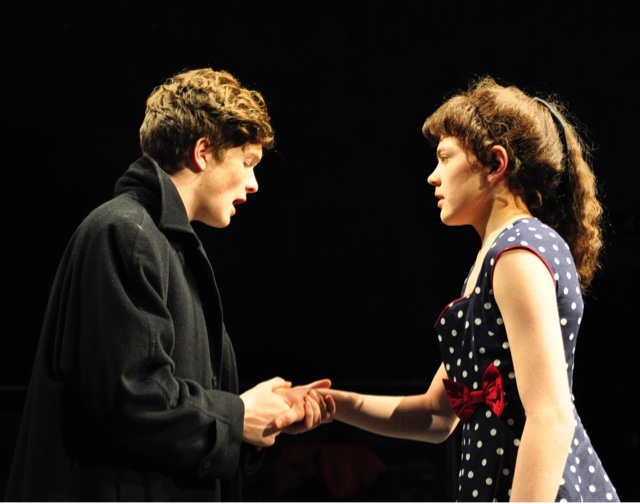
I described Always Orange as “devastating… important and necessary theatre” as I sat down in Susie’s Cafe Bar to recover (not that I think I will, could, or want to…). Having written twice, recently – Doctor Faustus, of course; and then Mrs Shakespeare – about “theatre as therapy”, this was probably the toughest (but most rewarding) of the three plays to sit through, for me: its depiction of post-traumatic memory searingly (and, in my case, tear-jerkingly, shoulder-shudderingly) accurate – and perfectly portrayed by the mesmerizing Ifan Meredith, as Joe (“a British man”).

Orange – Ifan Meredith (Joe) – photo by Richard Lakos/RSC

Fraser Grace’s writing is of the highest quality and laser-guided precision (the prologue reads as poetry; yet the craft is invisible). And, although he describes, in the (post)script, the perils of being ‘open’ – apart from the first and last, “the scenes… can be presented in any order” – I would really like to see the drama again (and again) with some of that chance shuffling (what I think of as ‘aleatoric’ art). This, perhaps, would emphasize “Joe’s confusion as a trick of memory – a product purely of his psychological state” more – something that is apparent, but not quite pivotal (from my extremely subjective perspective), in the ‘fixed’ version presented here.

Orange – Bally Gill (No Name) – photo by Richard Lakos/RSC

At the risk of imposing my own (so proximate that my face is identifiable from the marks left behind on the “so much glass in this place”) interpretation (or even will) on the play: with Joe so obviously the central character, I believe such variability would go some way to reflecting and stressing (if not actually explaining) that his “head and confidence is scrambled not because he is by nature a confused person, but because of an immensely traumatic event that happens in the physical world.” [And yes – as the founding member of Marloweholics Anonymous – I would be prepared to watch lots of these different iterations one after another.]

Orange – Bally Gill (Parvendra); Sam Cole (Niall); Bianca Stephens (Lorna) – photo by Richard Lakos/RSC

The company, here, is uniformly stunning – a perfect match for those perfect, powerful words. Not just the actors; but the creative team, too. There are some magical, abrupt, shocking – truly shocking – silences. Everything – whatever sense it affects – is there for a reason. This is so real. It is “how we live now” – but feels like it was written tomorrow. The unexpected connections the play makes are so utterly, chillingly plausible. Its switches of perspective non-judgmental and almost empathic.

Orange – Tyrone Huggins (Farouk) – photo by Richard Lakos/RSC

I don’t want to go into too much detail, for fear of revealing too much. All I would say is that this – by the slimmest of margins (see below) – is the one festival play I need to (and will) see again. (I would also suggest that you need to, as well.) This salient production defines why theatre is so crucial. It is also the RSC at the very top of its (perhaps unexpected) game.

Orange – Syreeta Kumar (Rusha) – photo by Richard Lakos/RSC

By the way: playing Joni Mitchell’s exquisite A Case of You as we left the theatre was a tiny act of apposite genius… – albeit one amongst so many.


Please don’t let this be my England…

Kingdom – Donna Banya (Aisha) – photo by Richard Lakos/RSC

The journey to write this play has been one of mixed emotions.
I don’t have all the answers.
What I do know is this;
We must get angry. We must stay angry. We must get organised.
Anger without strategy is futile.
Above all else we must connect, hear and protect each other.
Silence is not an option. It is in fact complicitness.
We are more powerful than we know.
Collectively.

Kingdom – Syreeta Kumar (Shabz); Laura Howard (Hawkins); Ifan Meredith (Archie) – photo by Richard Lakos/RSC

Utilizing most of the same brilliant cast of Always Orange, this similarly whacked me in the chest and head with vicious aptness. Not for personal reasons, this time; but topical ones. Donna Banya as Aisha was particularly persuasive – shattering, even. And yet it was Syreeta Kumar, as Shabz, who usurped my soul – just ahead of Laura Howard as Hawkins: whose disintegration, in parallel with devastating events, crumpled with transparent truth. Again, though, it is the cumulative forcefulness of the whole company – beginning, of course, with the playwright’s deep incisions into contemporary urban society (“Set in London. The belly of our beast. Heightened and dangerous.”) – which makes this so convincingly potent.

Kingdom – The company – photo by Richard Lakos/RSC

The repeated use of cubes – of various shapes, sizes, materials, contents – was a disquieting leitmotiv: but one, I think, which communicates in many ways. Not only is this a world of rigidly-compartmentalized thoughts; finite resources; fractured factions; of high-rise, faceless, empty blocks; it is one of fortification and hard edges (linking directly back to Revolt…) – and one where such established (establishment?) solidity needs to be continually softened, interrogated, challenged, disrupted; where boxes, containers (of any kind), need emptying, their contents modified or replaced; where, instead of being scattered, organization and cohesion could render them a concrete force for change. Thus, the masked Chorus was devastating in its tripartite, opaque, shape-shifting anonymity – especially contrasted with the clarity of the intensely personal portraits at the drama’s heart….

Kingdom – Laura Howard (Hawkins); Tyrone Huggins/Ifan Meredith/Bally Gill (Chorus) – photo by Richard Lakos/RSC

Go. Just go. Okay? And then get angry. Then organized. Really angry. And really, really organized.

Anger is to make you effective. That’s its survival function. That’s why it’s given to you. If it makes you ineffective, drop it like a hot potato.

Kingdom – Laura Howard (Hawkins); Ifan Meredith (Archie) – photo by Richard Lakos/RSC

Erica Whyman writes in the introduction to the scripts of Orange and Kingdom that they were “commissioned… in response to the provocation ‘What is unsayable in the 21st Century?’”. The answer – as I think it should be – is absolutely nothin’. And both these telling dramas demonstrate this rejoinder not just meaningfully and successfully; but, as Whyman says, “with exhilarating honesty [and] elegant and determined theatricality.” Buzz, I am sure, would be proud. Me? I’m still quite thrillingly boggled.

It is perhaps the artist’s most urgent responsibility – to disrupt, to perturb, to disconcert in order to reveal new ways of imagining the world – to make serious mischief. I hope these plays encourage us all to see a little differently.

Saturday, 12 March 2016

That’s life…!


That’s life (that’s life), that’s what all the people say
You’re ridin’ high in April, shot down in May
But I know I’m gonna change that tune
When I’m back on top, back on top in June

I said that’s life (that’s life), and as funny as it may seem
Some people get their kicks stompin’ on a dream
But I don’t let it, let it get me down
’Cause this fine old world, it keeps spinnin' around

I’ve been a puppet, a pauper, a pirate, a poet, a pawn and a king
I’ve been up and down and over and out and I know one thing
Each time I find myself flat on my face
I pick myself up and get back in the race

As regular readers of this blog – if any such creatures exist… – will know: I do not like, generally, to only attend one performance of a play. There are too many variables – and I believe you never see quite the same show twice.

I think I got all eleven scenes right at some point, but not on the same night. It’s like serving at tennis: some of the balls are aces, and some go into the net.
– Michael Pennington, in Performing King Lear by Jonathan Croall

A great deal, of course, depends on the audience: as returning to The Woman Hater, last night, quickly demonstrated. On Wednesday, those watching had been somewhat partisan – parents, peers, and those, like me, who just had brought a huge bucket of goodwill with them: wishing Edward’s Boys a whole heap of luck on their opening night; on the opening night of The Other Place… – and it showed. Especially in the first half, we hardly ever stopped laughing. We were willing the company on; and our appreciation was heightened by their concomitant response.

Last night, though, let’s just say it was a more ‘formal’ audience (although yet another full house…). Perhaps the majority did not know what to expect; or weren’t acclimatized to the barrage of early seventeenth century word-play? It was only when Mambo Italiano hit the runway, with the exuberant Jack Hawkins (as Oriana), that you could see the audience finally relax – aided and abetted by Joe Pocknell’s wonderful joshing and ad libbing (as Count Valore, below), giving them permission to have fun:

What Nobleman is that? all the Gallants on the Stage rise…

Although still not quite as responsive as Wednesday’s crowd, this did not appear in any way to affect the company. If anything, they rose to the occasion; and I felt that the play flowed even better (especially the ending; and the epilogue’s transposition into the final song and dance…). The cast – even though they hadn’t shown any first-night nerves – had tweaked those tiny misfires; checked there were no loose connections; and, as a result, the engine driving, powering them on, was now perfectly tuned. Even if the audience wasn’t as involved, this didn’t mean that they wouldn’t give the best performance possible!


Additionally, a second viewing enables you to spot those things you missed before. And I felt, this time around, that Dominic Howden (Lucio) – especially in the Lazarillo ‘trial’ scene – exhibited great strength. This was power and confidence in habitual display:

Sir, your long practice in the State, under a great man, hath led you to much experience.

Additionally, Finlay Hatch (Duke of Milan) was even more convincing, I thought. There was a noticeable weight removed from his shoulders – a change from stiff to relaxed; glowering to content – when Oriana said yes to his ‘proposal’:

Best of all comforts, may I take this hand, and call it mine?

What I should also reinforce is all of the actors’ innate maturity. Off the stage, each one is simply “the whining schoolboy, with his satchel And shining morning face, creeping like snail Unwillingly to school”. But, once in character, they are that character; and they are whatever age (and sex) they are required to be. Quite astounding, really – but such is the transparency of (what I can only call) the great thespian’s art.


Having been immersed for far too long in Jacobethan/early modern drama, only at the interval did I register the sheer invisibility of the actors’ consistent – and enviable – ability to also render four-centuries-old language into conversational, comprehensible, natural-sounding English. [As this is not always the case, even with professional actors, I will be taking a look at some of Edward’s Boys’ previous productions on DVD – especially at Henry V – there to revel in my favourite Shakespeare speech – “This day is called the feast of Crispian…” – and to see how it stacks up against Larry Olivier!]

As Mark Ellis – who is in charge of publicity; and produced the programme (including taking all the cast photographs); and to whom I owe much thanks… – also pointed out to me – which, again, was a property of stagecraft so transparent that, I suppose, I had previously taken it for granted – was – especially with the absence of any sort of set or stage design – the boys’ ability to imply, to create, the spaces around them: making you feel you were there; were also seeing what they were imagining, manufacturing… – not only with their dialogue, but with their actions (and re-actions). It felt as if they were painting four-dimensional pictures for you, on the blank canvas of the bare walkway, in the air, and in time. Building the walls (and when so closed-in by the audience that sometimes those walls were the audience; other times, making us fade beyond mere furniture, or obstacle… or even presence…) – and piercing them with windows and doors – and all in your mind. One moment, the Mercer’s clothes shop. The next, outside, in the streets of Milan. Or in Gondarino’s house: with a hailstorm rattling on outside. The intangible made solid.

Only at the end did this fabric ‘dissolve’ – the shifting, shuttering fourth wall becoming permanent again… – as everyone gathered on stage: gradually building to a whirling dervish of a group scrum, whilst singing That’s Life with as much happiness and vigour as one could ever hope for! (And after all that hard work.) A great way to finish – an essential summation of all that was so very, very special.

Thursday, 10 March 2016

And the piece of Cod, which passeth all understanding…

Artwork by David Troughton/Edward’s Boys

Why and how choirboys originally chosen to sing hymns came to be part-time actors in Christmas pageants and morality plays, and then recruited or forced to be full-time actors in immorality plays, is itself an interesting story, but when Beaumont and Fletcher were starting out, boys companies like The Children of St. Paul’s were all the rage in London. For the English gentry to gather in their darkened ‘private’ theatres to hear and see a rosy-cheeked, soprano-voiced choirboy in a dress tell another rosy-cheeked alto-voiced choirboy in a beard, “It is impossible to Ravish mee, I am soe willing” …well, maybe what is true for all theatre – and not for television – is especially true for the 17th century: you had to be there.

I was there. Not time-travelling (well, not so much; although yesterday morning’s weather was most apt). Yet it did feel like a little piece of theatrical history was being made.

Having been, initially, dragged to plays at “the most productive tin hut in history” when I was a reluctant teenager; and having witnessed my last, most memorable, King Lear there, just before it finished its duty as The Courtyard Theatre; last night I was fortunate to be in the audience for the opening night of the first drama to be staged in the resurrected The Other Place, and its new, intimate Studio Theatre – The Woman Hater, by Francis Beaumont (possibly with a little help from his friend, John Fletcher – see below); presented by Edward’s Boys, directed by Perry Mills; and billed as “a lost gem of Jacobean theatre whose themes of gender politics, racial tension and homeland security are strikingly relevant to our day”:

An outrageous City Comedy and sharp satire, The Woman Hater was first (and last) performed by “Paul’s Boys” in 1606. Beaumont’s first play is now revived by Edward’s Boys, the renowned boys’ company from Shakespeare’s School. Previous successes include The Lady’s Trial and Galatea at the Sam Wanamaker Playhouse and Henry V at the Swan Theatre.
     This production is set in 1950s Italy and features live music, an outrageous parody of the discovery by spies of a plot to assassinate the Leader of State (a few months earlier London had been shaken by the exposure of the Gunpowder Plot) [“Oh, Fawkes!”] and many satiric references to the plays of Shakespeare [including “a pair of deceitful legs belonging to a glover’s son at court”]. And a fish head…


If Beaumont is mentioned at all these days it is usually in conjunction with his more famous collaborator John Fletcher (“Bo’mon’n’Fletcha”!) – probably a result of the fact that “Fletcha” also collaborated with someone called Shakespeare. However, Beaumont wrote plays on his own and one at least, The Knight of the Burning Pestle, has a strong reputation following several successful productions in recent decades.

Oh, and like that “someone” – i.e. another “leading dramatist and poet” (and I don’t mean Cervantes) – it is also four hundred years since Francis “never more than Frank” Beaumont died – almost to the day – on 6 March 1616. (He, too, is buried in his local church – in this case, Westminster Abbey.)


Beaumont juggles four plots with considerable ease, offering a bit of something for everyone: farce, bawdy wit, court satire, and a ‘high’ romantic plot.
– Lee Bliss: Beaumont and Fletcher

There is probably very little reason (or sense) in attempting to explain the story, and its multiple strands, in detail – probably because what there is of it – as you may have surmised from the snapshot above – is both happily ludicrous and sadly (perhaps) not quite fully developed (in other words, perfect for contemporaneous opera). To be honest, none of this really matters – although, with a little added exposition, and a bit of tinkering under the hood (oo-er, missus) – I think the play could be just as insightful (and even as feminist) as, say, The Roaring Girl. Although I’m still not quite sure why (even after re-reading the original text) – although I suspect it was down to the accomplished, gleeful camaraderie of all involved… – it was certainly just as uproariously entertaining: at least as presented here!

What narrative there is, though – and there are, of course, those subplots of increasing preposterousness: which somehow almost manage to conjoin (fnarr fnarr), to resolve into something meaningful – is enough of a skeleton for Edward’s Boys – “one of the hottest tickets around” – to clothe it in sumptuous fabrics of great joy, confidence, humour; and then reanimate it with the ultimate skill, and extremely ribald wit. (Try saying that quickly.)

The Prologue (adapted for this production) is, however, a little disingenuous. As this run’s publicity so gleefully proclaims: “like many of the boys’ plays, it is filthy, shocking and deeply offensive in general” (nay, nay, and thrice nay…) –

Gentlemen, Inductions are out of date, and a Prologue in Verse, is as stale as a black Velvet Cloak, and a Bay Garland: therefore you shall have it plain Prose, thus: If there be any amongst you, that come to hear lascivious Scenes, let them depart: for I do pronounce this, to the utter discomfort of all twopenny Gallery men, you shall have no bawdery in it…. I dare not call it Comedy or Tragedy; ’tis perfectly neither: A Play it is, which was meant to make you laugh, how it [will] please you, is not written in my Part: for though you should like it to day, perhaps your selves know not how you should digest it to morrow….

A pertinent admonition to reviewers – such as I – if ever there was one. (So I will be going back for the second showing – just in case.)

Finlay Hatch (Duke of Milan); and Jack Hawkins (Oriana) – photo by Mark Ellis/Edward’s Boys

I came away with great joy in my heart; as well as Mambo Italiano cycling gleefully around my mind. That decision to set the production “in 1950s Italy” (“Milan in 1954”, the precise programme notes tell us…) paid dividends: allowing echoes of the Mafia (a conscious violin case in the opening scene; readily-drawn pocket revolvers as weapons; natty suits, matching hats; and incredibly stylish, fresh haircuts…) and the Rat Pack – as well as some deft religious hints – to link cleverly with the overall tight-knit nature of the dramatis personae.

To say I was impressed with the calibre of the acting would be an understatement. There was a cohesive confidence that almost glowed…. But where to start? The top of the cast list seems like a good idea! (Just for the halibut.)

Finlay Hatch was a suitably menacing and petulant, potent, lovelorn Duke of Milan (or, possibly, the Codfather… (if you can think of a better title, please let minnow)): ready, at any moment, with his strong, physical presence, to ensure – via his reliable henchmen (or ‘Servants’) – that anyone who got in his way would soon be sleeping with the fishes. (No: not like that… – although Daniel Power’s galloping gourmand, Lazarillo; “a voluptuous Smell-Feast” – just the right side of caricature – certainly wouldn’t have minded!) Joe Pocknell was utterly superb as the manipulative, swaggering Count Valore – although there was not much ‘valour’ (apart from constant loyalty to his sister, Oriana) to be found in the way he constantly manipulated those around him. This was a suave and sophisticated central performance of great merit and maturity. He ruled the stage, as well as those around him.

Ben Clarke showed great emotional depth as Arrigo – especially in the scene where he confronted Oriana. He is not quite the stooge he first appears to be; and his development throughout the play was beautifully measured. Dominic Howden (who was also half of the sound production team), as Arrigo’s sidekick, Lucio, also grew in power and presence (oh, behave!) – especially in the scene where he dons his “Gown I use to read Petitions in”, and proceeds to (try and) condemn Lazarillo to be hanged for the treason he so obviously hasn’t committed. [Are you following this? Follow the umbrana, and it all makes sense. I promise. (You could say that it was all just a little bit fishy, to be honest. In fact, I was surprised Robson Green wasn’t on stage, with his tackle out. (Madam – please…!))]

Daniel Power (Lazarillo); and Ritvick Nagar (Boy) – photo by Mark Ellis/Edward’s Boys

Ritvick Nagar – as Lazarillo’s ‘Boy’ – was my performer of the night (but only by the teensiest of whiskers): shadowing (with a clever reversal of grease-stained-and-spotless, monochrome costumes) his ‘master’ effortlessly; continually taking the, er, piscatorial; always ready with a retort. Like many such servants – Volpone’s Mosca; or Valentine’s Jeremy – his job is the reverse of its description: he taunts, rather than assists; ridicules, rather than attends; and yet, is somehow, always at hand – with a keen sardonic smile – to not quite deliver what is asked of him. This kid will go far, that’s for sure!

Pascal Vogiaridis was surely born to play Harry Potter, with those glasses… – and was a sparkling delight, every time he appeared as the Mercer (“he deals in fancy fabrics”): even when duped into marriage. His slumped sadness, though, at such a fate, tugged at my heartstrings. George Hodson, as the Pandar (“a Pimp” – echoing The Jew of Malta, perhaps) who so niftily lures the Mercer in, wore his confidence constantly as a snide badge of pride. (Boo, hiss!)

Adam Hardy and Isaac Sergeant kept cropping up all over the place (as ‘Gentleman’, ‘Servant’, ‘Mercer’s Prentice’, etc. – as well as some rather hefty “ladies” at the end, I think: it was hard to tell under those wigs…); and, along with Nick Jones and Alistair Campbell – as a pair of almost Marxian (and utterly stupid) ‘Intelligencers’, or gumshoes (always getting the wrong end of all the sticks thrown at them by Valore) – demonstrated keenly the consistent strength and depth of the cast. As the closing number so ably showed: this was a company built on mutual admiration and support… – so thrilling to see in actors this young.

Adam Hardy (Servant 1); Daniel Wilkinson (Gondarino); and Isaac Sergeant (Servant 2) – photo by Mark Ellis/Edward’s Boys

So what about the ‘female’ members? (Yes, missus.) Jack Hawkins’ portrayal of Oriana [Valore’s sister – remember?] was a thing (no; just no…) of magical, magnificent, studied strength: from her effortless, endless teasing of Gondarino (the titular – stop it – Woman Hater) – including her entrancing rendition of Mambo Italiano in the first half – to her sullenness; her desire to die rather than be dishonoured; and her final, eventual ‘acceptance’ (see, this it where the play loses its feminist edge – and it was doing so well…) of marriage with the Duke. (“I’m gonna make her an offer she can’t refuse.”) Hawkins – along with the other ‘girls’, and their utterly convincing portrayals – proves both the viability of, and rationale for, boy companies. Special mention must therefore also go to Charlie Waters as Julia (eventually Mrs Lazarillo) – and his stunning, pure singing voice – Felix Crabtree as the cheeky Francissina (eventually Mrs Mercer); and Abhi Gowda as Oriana’s gentle, patient, constant companion and ‘Waiting-Woman’.

James Williams – whilst craftily beginning his transformation to a spectacularly hammy ‘Deaf Gentlewoman’ (a great contrast with those ‘true’ feminine characters) – deftly delivered that Prologue; and effectively anchored the whole shenanigans by removing his wig to then deliver the Epilogue. His is an assured and knowing presence, with a keen knack for commanding an audience.

And, then, finally, there is that mysogynist, Gondarino – portrayed so fearlessly and assuredly by Daniel Wilkinson. Daniel Power’s Lazarillo may have ensnared us all with his witty, exaggerated-yet-subtle buffoonery – reinforcing the subtitle of ‘The Hungry Courtier’ (in many ways, with equal weighting) with aplomb; plumbing the heights and scaling (ba-dum-tish) the depths of pathos and bathos – but it was Wilkinson’s indestructible inhabitation of his (in many, many ways, unsympathetic) character that will stay with me: from his nervous tics, wringing of hands, to his rapid shifts of gear, mood and desire. This was tremendous stagecraft – when surrounded by so much tremendous stagecraft… – and it would have been easy to overact the rôle in the mode of, say, Kenneth Williams or Frankie Howerd. But he made both “Comedy” and “Tragedy” his own. Overawing, insightful, magnetic, inspiring talent. Bravo!


Overall, the play, I thought, was paced well-nigh perfectly – you could even say it was turbot-charged… (sorry) – the descent into deep darkness in the shorter, second half contrasted well with the extended humour that went before and after. There were some lovely, flawlessly-integrated musical moments (with Maninder Dhami, Patrick Ellis, and Thomas Banbury; directed by Ben Dennes – all appearing on-stage); and the consistent periodicity of all aspects – with an almost complete absence of set (except for the low-key suggestions of the power of both state and church) – worked extremely successfully.


I understand why the ‘stage’ area – to fit in with other venues – was arranged as it was (a long axis, with a couple of central, crossing, side entries – with much audience participation (willing or not)); but I am not sure (having tried both the superb new audio loop – yay! – as well as directly accessing the sound through my hearing aids) if the acoustics of The Studio Theatre are less ‘echoey’ when the new seating (which was cleverly folded away into the end wall) is deployed. Officially – and there was a definite charm to being in a not-quite-finished theatre building… – The Other Place doesn’t open for a couple of weeks: so only time will tell. It is to the credit of all the actors that I heard them quite clearly.


I walk past The Other Place – habitually telling the inspirational Buzz Goodbody how much she is missed (as well as saying “Hello Forever” to the ineffable Norman Rodway…) – most times I am in Stratford-upon-Avon; and it felt so good, last night – as I wandered back to my car, reverting to the present, passing her memorial stone once again – to know that the wonderful work she initiated still continues, still grows – and in a manner I hope she would have applauded as enthusiastically as this happy, dispersing audience. Fabulous!

Thus through the doubtful streams of joy and grief,
True Love doth wade, and finds at last relief.


Poster by David Troughton/Edward’s Boys

Edward’s Boys
Edward’s Boys – an all-boy theatre company comprising students from King Edward VI School – Stratford-upon-Avon (“Shakespeare’s School”), have received academic attention and popular success as a result of their work exploring the repertoire of the boys’ companies from the early modern period. In the words of Dr Emma Smith (University of Oxford), the Edward’s Boys project “is the most sustained attempt to re-imagine what we think boy companies could do – and it will really rewrite the academic theatre history books”. All of their previous performances are now available on DVD.

The Woman Hater
There are two performances at The Other Place (formerly The Courtyard Theatre) in Stratford-upon-Avon on Wednesday, 9 and Friday, 11 March 2016 [now sold out] at 19:30. (The Other Place site will open to the public from Monday, 21 March 2016.)
     On Thursday, 10 March 2016 there is a performance at The Oxford University Catholic Chaplaincy; and on Saturday, 12 March 2016 at King’s College London Chapel (both 19:30). Tickets for these performances are available here.
     The production then goes on tour to France: where audiences in Montpellier and Beziers will have a first chance to sample a unique slice of English theatrical history.
     For further information, please contact Richard Pearson at King Edward VI School (01789 203104).

Daniel Wilkinson (Gondarino), in rehearsal – photo by Mark Ellis/Edward’s Boys