Showing posts with label Cumbria. Show all posts

Wednesday, 30 April 2025

The old man and the tarn…

For Paul Besley… — inspired by him, his writing, and a recent visit to Eel Tarn.

As the Sun also rises, so the Moon rests. Its waning glow, low in the mauve sky as it drew the Man here, has departed. But he still feeds off its allure as his pulse climbs, and he pauses, breathing hard, summoning support, as well as the air he so craves. He moves on to meet the dawn, pushing his body well beyond the valley-bound limits it frequently fights to meet. This race was too urgent to refuse, and all obstacles must be overcome, or sidelined.

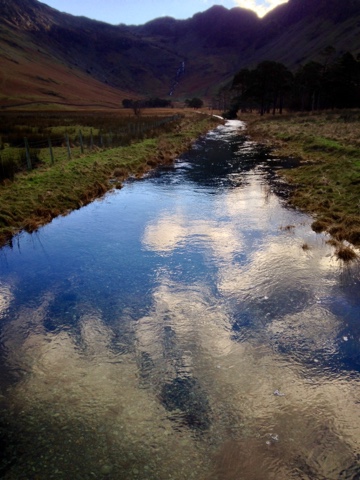
Few creatures stir so early, the young calves so puzzled by his appearance that they cannot label him good nor bad, so regard him as both. Finally, they return to their cud-chewing amongst the muddy grass. Even after such a long absence of rain, some becks still happily feed the ground. The Man tracks this one eagerly; then turns from it to face down the radiant horizon.

Friday, 21 March 2025

The answer, my friend, is blowin’ in the wind…

The ballad of Woodhouse Colliery

the siren blasts pre-dawn today
wakes the locals at five-thirty
it is time it screams for the chosen few
to get down deep and come up dirty

what we do is what our grandas did
it made some sense back then
when our father was nobbut a gangly kid
but (umm) have you seen the papers

our houses cost nearly nothing we’re told
too small too cramped so old and cold
yet there are some who fail to afford them
so they go and do what their grandas did
when their father was nobbut a kid

but not to power a nation this time
this time they’re making nowt
unless you consider the world’s biggest hole
the country’s nuclear dustbin
an achievement of sorts
rather than an act of futility
a great big hole of nothingness
devoid of all utility

they are scouring the planet’s intestines
not producing the value of old
as they know it’s only shit they shovel
not exhuming a dark form of gold

what we do is what our grandas did
it made some sense back then
when our father was nobbut a gangly kid
but (umm) have you seen the papers

dig it big enough they say
and all Sellafield will fit
but what will they do with the great big hole
where that festering factory used to sit

they’ll build a mountain of excrement
unneeded to the sky
and add another Wainwright
where the fulmars used to fly


Tuesday, 29 December 2015

The long and winding road…


After a day trapped inside, ambushed by the deepest, dankest monsoon, Sunday’s dawning brought with it a spectacularly clear sky: and only the northern Pennines, morphing into the majestic Howgill Fells, just waking, to my right – constant, lumbering, reclining colossi – were still snugly covered beneath the cotton-wool-drifted quilt of rising dawn moisture, softening their sharp bulk.


Leaving the motorway, and arriving in the Lake District proper: as I passed Scales on the main road, those majestic mountains reared up in front of me – Blencathra almost friendly, welcoming – glowing a glorious rich russet; with their own topping wisps of remaining cloud floating away, lazily and gently, on the surprisingly lethargic breeze.

All the way, I had followed the sentinel just-past-full moon – a guardian and a guide – the low, bright lunar globe leading me to the turning I wanted at Braithwaite; before descending to its own long orbiting sleep behind the north-western summits.

Hugging the Derwent Fells, the familiar narrow road leads to a small, ancient bridge just before Birkrigg – but mouldered now into the grown-riverlike Rigg Beck beneath – the first vestige of the struggles I had, thus far, only seen in the news. Fortunately, the gushing ford that ran next to the footbridge was passable – but only with immense care and forethought. Had I not a vehicle designed to conquer such challenging terrain (and the knowledge to go with it), I would have mourned my annual return to “the lake by the dairy pastures”; but, surely, in this small paradise, readily found another delightful destination. (Cartmel – which my iPad’s autocorrect decided should be “Caramel” – which seems apposite – Priory, again, maybe; or “old man’s mountain” Gummer’s How – surely, on such a glorious day, one of the Lake District’s more achievable, and far-seeing, vantage points? (In August, visibility had been minimal; the ascent and descent treacherous; the weather then damp, belligerent, and bitter.))


Having waded through this first obstacle, still I went on with deep trepidation. At points – especially the final descent, beyond Newlands Hause – torrents of water rendered the 25% inclines deceptive, untrustworthy waterways. Landslips had mostly been cleared; but the surface of the road was littered with debris: mud, wrack, tangled branches, scree. My 4x4 was as sure-footed as a mountain goat, though: enabling me to concentrate with long-held breaths, and steer slowly and cautiously to my morning’s destination.


I was the second to arrive at Buttermere: chatting for a while with the seasoned, hardy soul about to set off to reconquer Haystacks and the ridge along Seat, High Crag, High Stile, Red Pike, before returning via Dodd and Old Burtness.


His love for the mountains was obvious: as was his preparedness. He, too, had arrived via challenges and setbacks – but also would not be thwarted in his goal!


I parked next to Mill Beck, which feeds into Crummock Water. It bubbled and frothed with a rabid anger that had not only destroyed the fences which usually ran alongside, but filled me with a foreboding that I would not be able to complete my planned circuit.


No snow remained: although torrents poured down from every crevice. Water, water everywhere – turning roads and paths into rivers, streams, and sometime waterfalls.


The walk itself was more hazardous than in previous years: well-trodden ways now well under water; sodden ground; routes blocked by serried, toppled, shallow-rooted pines. At one point, I had to scramble along a short rockface: hunting with amazed joy (and the memories of long-forgotten youthful climbing) for hand- and foot-holds – true crag-hopping (albeit in extreme slow-motion) – before descending to the remains of the eroded, slate-pebble-dashed path below. (My damaged body will take weeks to recover from this punishment, I know. But my mind will leap forever with joy at each similar memory.)


Conditions could have been so much worse: recent wrack-marks demonstrated how much higher the mere had lapped – obliterating any chance of traversing its shoreline.


Just past the obstacle course of fallen trees, I encountered a toddler (with justifiably proud mum) entranced with my reflective sunglasses, bush-hat and fingerless gloves. This was one happy child – with an even better outfit than mine! – determined and communicative; and aiming to complete the circuit with a big grin that warmed the heart. I truly hope they succeeded. They deserved to on such a day; and with such spirit.


But, of course, everyone I encountered said hello. Some stopped to chat, as well; and there was a comradely courtesy – holding gates open; advising about obstacles ahead; suggesting diversions… – but all of us glorying in the sunshine hovering above us.


At this time of year – even when all the sun can do is paint the sky a vivid cobalt, and tint the surrounding, cradling peaks with gold flames, without ever reaching the mere itself – this remains such a beautiful, yet sometimes harrowing, place: the true definition of the ‘picturesque’.


I must have been born without the traditional-English-stiff-upper-lip gene: and, as a result, there is a direct line drawn from external, ineffable beauty – whether that be music, art, poetry, sculpture, landscape… – to the core of my creative, sensitive, romantic soul.


Standing once again on Peggy’s Bridge, at the entrance to the Scarth Gap (I expected orcs), gazing back towards my starting point below High House Crag – Haystacks and Fleetwith Pike glowering menacingly dark behind me…… – dear reader, I admit that, silently, I cried.


The overwhelming assault of magnificence flooded my senses. (There was no room, today, for music.) Truly, this is a place where there is a surfeit of glory and grandeur – enough to emotionally sustain one for a lifetime.


I do not believe in any deity – yet this felt like an epiphany, a conversion (albeit on the path to Gatesgarth Farm).


As I returned to the sanctuary of my car, I was rewarded with one of my favourite sights: four keen Border Collies, expertly controlled with the subtlest of commands, manoeuvring a small flock of muddy Herdwicks to less waterlogged pastures.


Such skill; such innate teamwork; corralling them seamlessly and cohesively through a series of gates along narrow tracks. The oldest dog had a withered rear leg – but this was no impediment – this was an independent, sharp spirit, tugging at the boundaries of control, and obviously gleeful in its well-earned freedom.


Later, with such perfect weather for wandering – although, returning to my hotel, I would discover that my cheeks and forehead had been sanded rough and raw by the prevailing wind – the car park behind the Fish Inn grew full; and the paths and roads around the mere grew busy with companion walkers and cyclists. (Last Christmas, I departed as only the second car of the day arrived – such was its peace.) Such busy-ness, this time, made the place safer, though – essential when each turn of a corner presented unexpected vistas and occasional risks.


Not wanting to repeat my morning’s daring adventures, I returned to the A66 via the Honister Pass (which I had been told by my earlier associate was clear and dry) – pausing below the rugged, stunning Seatoller Fell to wonder at the surrounding might. Beautiful Borrowdale (I expected hobbits) glowed golden and welcoming, below, bathed in a beautiful, warm, umber light. But, beyond, yet more stark evidence – an almost infinite sea, where Derwent Water had once lain peacefully: at some points reaching out to stroke the road’s edge. In Keswick, the worst-affected households were marked by cairns of damaged white goods and furniture – and yet the town was very much buzzing with life.


This had been Buttermere at its very best: not as placid and tranquil as perhaps it can be (and is often imagined). But the Lake District as a whole is still struggling: and needs as many visitors, as much help – along with Lancashire, Calderdale, etc. – as it can get. Go visit! Cumbria is open! (But please – with Storm Frank on the way – be careful out there.)


Thursday, 25 December 2014

Oh, morning, at the brown brink…


All I ask for, at the end, is a last long resting place by the side of Innominate Tarn, on Haystacks, where the water gently laps the gravelly shore and the heather blooms and Pillar and Gable keep unfailing watch. A quiet place, a lonely place. I shall go to it, for the last time, and be carried: someone who knew me in life will take me and empty me out of a little box and leave me there alone. And if you, dear reader, should get a bit of grit in your boot as you are crossing Haystacks in the years to come, please treat it with respect. It might be me.
– Alfred Wainwright: Memoirs of a Fellwalker

The north-western fells of the Lake District have a very limited colour range at this time of year: the dark green of the conifers; the almost-lime green of moss and grass; the rust of dying bracken, fallen leaves and pine needles; the grey-green of slate; and dark grey of the peaks, silhouetted against the steely sky – or, if you are lucky, glowing gold beneath emerging patches of blue – tinting the choppy lakes…. Green; orange; grey – with the occasional silver glint of vertiginous streams, or streak of snow. A gift to screen-printers; and absolutely beautiful to behold – even in a howling gale, when the sleet is battering your face at over 40 mph…! (I’m a northerner by birth, and by inclination: so am allowed such masochism.) Fortunately, the wind was blowing towards Wainwright’s beloved Haystacks: cradling Innominate Tarn, as it should… – but adding my face to to the local palette: a glowing, windburnt ruddiness.


Such was an almost deserted Buttermere, early last Saturday (when everyone else – if the roads were anything to go by – was out, manically Christmas shopping). Pottering around a small lake is much more preferable, to my mind – whatever the weather: especially when you can count the like-minded people you meet on the fingers of one necessary glove. And my perseverance was rewarded. Even though the wind never dropped, it did clear some of the clouds away from the majority of summits – revealing their true glory, transforming threatening giants into warm-hearted friends: especially the “fell with the prosaic name”, Robinson.

The Buttermere valley is robbed of winter sunshine by a rugged mountain wall exceeding two thousand feet in height and of unusual steepness, its serrated skyline seeming almost to threaten the green fields and dark lake and homesteads far below in its shadow. No mountain range in Lakeland is more dramatically impressive than this, no other more spectacularly sculptured…. Here the scenery assumes truly Alpine characteristics, yet without sacrifice of the intimate charms, the romantic atmosphere, found in Lakeland and nowhere else….


As I walked, I found myself humming the perfectly-ambling-paced Prelude from Holst’s Brook Green Suite – used as the theme music for Eric Robson’s television series of walks with “A.W.” – and it’s difficult to think of a more appropriate accompaniment, even in such challenging conditions (although Brook Green, as a place, itself couldn’t be more different).

On a better day – better for my health, as well as the weather – I might even have hauled myself up Buttermere Fell through the welcoming Scarth Gap (as did one lonely, better-equipped soul – aiming to descend later past Green Crag… – who I met at the southern end of the lake, crossing Warnscale Beck at Peggy’s Bridge) to pay my respects to the man himself at Innominate Tarn. But the granite crest of Haystacks, today, and from this perspective, never looked anything other than its usual forbidding self: a suitable sentinel for such a private – and great – individual. As the man himself wrote: “The Buttermere aspect is the better known, although this side is often dark in shadow and seen only as a silhouette against the sky: here, above Warnscale, is a great wall of crags…. The only advice that can be given to a novice lost on Haystacks in mist is that he should kneel down and pray for safe deliverance.”

Once up there – and it isn’t that tough a climb, really, at around 400 metres – as I know from a youth filled with fellwalking: you will find nothing other than a rewarding, but tough, beauty – the perfect definition of grandeur – that will never leave you (and that you will find very tough to leave – as did Wainwright…).


Writing this, a few days later, on Christmas Eve, supping a pint of Wainwright “exquisitely lovely” golden ale, I can remember almost every step taken: beginning with the walk from the car park behind the Fish Inn; Rannerdale Knotts (“a mountain in miniature, and a proud one”) a perfect backdrop… – not just because the ground beneath your feet varies so much, in level, texture, solidity: ranging from smooth, manmade paths; the damp cushioning of moulding leaves; false friends of less-than-stable slabs of slippery rock; tree roots almost fossilized by the frequent tread of boots; and temporary waterfalls rushing across where the trail once was… – but also because of that allure: every short stride bringing a new perspective (as well as a new photo opportunity… – even with my iPhone battery dying halfway round, I took over one hundred photographs…!).

As I turned, at the far end of the lake, approaching Gatesgarth Farm, I had a real feeling of déjà vu… – Fleetwith Pike rising majestically above a small group of trees… – “Ah: so that’s where the cover of Wainwright’s The Western Fells is!” [And that’s where the majority of the quotations come from (being his last Pictorial Guide to the Lakeland Fells: “Thus a 13-year plan was finished one week ahead of schedule…”) – along with a smattering from The North Western Fells – as he uses the valley of the Cocker, “jewelled by the lovely lakes of Buttermere and Crummock Water”, as a convenient boundary between the two books.]


Returning along the northern shore of the lake (including the unique Hassness tunnel), you certainly look more down than up – and I never once forgot to watch where I was putting my feet, as Wainwright often prompts… – although Mellbreak, once cleared of cloud, was a great target: and stood as encouragement to keep up the pace (although I must admit to flagging terribly at Wilkinsyke Farm: using the excuse of a young border collie’s eagerness to stop and rest my legs, before the wobbly charge of the last few hundred metres; a change of boots and socks; and a final peeling of layers…).

The world is charged with the grandeur of God.
     It will flame out, like shining from shook foil;
     It gathers to a greatness, like the ooze of oil
Crushed. Why do men then now not reck his rod?
Generations have trod, have trod, have trod;
     And all is seared with trade; bleared, smeared with toil;
     And wears man’s smudge and shares man’s smell: the soil
Is bare now, nor can foot feel, being shod.
– Gerard Manley Hopkins: God’s Grandeur


Monday, 10 March 2014

Arnside and the Knott…


Arnside – on the Lancashire/Cumbria border – is one of those places you pass by (with little, if any, thought) on the way to the Lake District. Ignoring it – as I have often done – is unfair, though. Looking to walk somewhere that I hoped would be quiet (and was), on a Saturday that hinted at a soon-to-be spring, I therefore parked early on the Promenade, and decided to be led by the signs drawing both the wary and unwary onwards and upwards to the summit of ‘The Knott’.

I know I’m not as fit as I once was (by a very long way): and the increasingly steep 159-metre climb from sea-level left me gasping for air, and in worse shape – temporarily – than the trees sculpted and stunted by the permanent on-shore winds (gusting up to fifty miles per hour, when I was there: although it felt like such gusts were actually the norm…). Fortunately, once you leave behind the bigger houses, with the bigger views, there are frequent benches for the weary of limb, but ambitious (and stubborn) of mind – although often at view-points (and, therefore, gust-points) that turn into one vast, glorious panorama, as you near the top.


I’m sure, on a clear day, the vista of the Lakeland fells would be more than enough reward; but, even on a day marked by gloom (only lifting in my rear-view mirror, as I headed back towards the M6), there was an air of rugged, blurred mystery about the scene below me: looking across to Grange-over-Sands and along Morecambe Bay and the Kent Estuary – clogged with orange, grey and dull brown, dangerous, deceiving sands – and this was sufficient a prize (along with knowing that I had, for a moment, overcome the permanent pain that sears through my body, that would hold me back; and appearing to be the only soul around).

If it hadn’t been so very breezy and chill up there (even the birds were hiding – apart from the odd intrepid, acrobatic raven), I would have stayed longer – there are paths and paths to be followed and tempted by: of scree, grass, rock, and occasionally mud. Even with gloves, and many layers, the plethora of coffee-shops and cafés on the Promenade was too tempting. My timing was good, as well: as, descending, I met a large party of hail fellows well met, who had cleared the tables of one of those eateries before setting off to also conquer the local summit.


The town itself puts up a staunch front against the prevailing weather; and, I suppose, could appear forbidding in its apparent greyness. However, it is an honest place; and the houses jostle agreeably for position and prospect on the slopes down to the Prom: a short walk taking you past what looked (and smelled) like an excellent chippy (not quite open for lunch) to a typically scenic coastal railway station – its long line stretching purposefully across the tide to Grange and beyond.


Returning to the town via Church Hill, I headed off, suitably fortified, towards New Barns Bay. I should have left my walking boots on, though: as the concrete path soon crumbles, once past the lifeboat station and old boatyard – so I sat, photographed, and collected my thoughts.

Definitely a place worth returning to: when the sun is shining (and not just a broken promise); the breezes are gentle; when the fish and chip shop is open. However, then, I fear, I will be amongst crowds – some of whom learned long ago of its secretive and subtle delights.