Showing posts with label Prokofiev. Show all posts

Tuesday, 5 July 2016

He marched them up to the top of the hill…


Although billed simply as a concert of “Family Classics”, Sunday afternoon’s performance by the Cheltenham Symphony Orchestra at Pittville Pump Room was really about painting pictures; crystallizing moments and places in time – each in a different country; a different climate; a different medium. And even though every piece was familiar (“classics” in both senses), this did not mean any subsequent dimming of the CSO’s habitual – one might say trademark – passion: either in effort or emotion. As always, their sound was spine-tingling and resonant; full of precision and love (of communication; of music; of involvement). I may have left Cheltenham with the closing ascents of the cellos and double-basses pulsing through the soles of my feet; but I was still somehow hovering a few millimetres above the ground (as I always am after their concerts); my soul raised ever so slightly further heavenwards; my heart light as air – both filled with intoxicating and inspiring joy.

This was an artistic Grand Tour – not of forgotten fusty museums or dusky, dusty long-galleries – but one that ensured our minds and lungs were filled with freshness and vitality: as canvases, boards and reams of fine paper were coloured before us en plein air, under some fascinating skies.


First, sultry southern Spain: and a wonderful, perfectly-targeted introductory chat from cellist Stephen Pett – who then went on to conduct a selection of pieces from Bizet’s second Carmen suite in a beautifully crisp, energetic and flawlessly communicative fashion: eliciting some magically responsive playing from all sections of the CSO (with especial awe for their as-always stunning brass section – especially lead trumpeter Paul Broekman: who was on sizzling form). The percussionists – more of which, later – were also spectacular in their commitment to transport us to the baking esplanadas, plazas de toros, and that famed fábrica de cigarillos.

Yes, this was the top four of Bizet’s greatest hits; but familiarity, here, bred admiration. Thrilling, persuasive and ardent; and with fresh insights galore (subtle changes of tempo and dynamics; and no giving in to the urge to rush or to gloat). A lack of bombast, and a constant glow of sublimity, thus helped produce a powerful, detailed rendering of all those (in)famous operatic characters – more a skilfully-crafted, insightful, mesmerisingly three-dimensional bright, sun-baked pastel, though, than a coarse, broad-brushstroke oil-painting. Vivid, yes; but not crude; impressively considered and charismatically intelligent. The deeper the gaze, the more transcendent minutiae emerged. Simply put, a beautiful combination of zeal and skill. What a great way to start our tour of mainland Europe!


Then, suddenly, we were whisked away to the cooler, more crystalline meadows and forests of fairytale Russia for Prokofiev’s enticing Peter and the Wolf. This is where the woodwind worked their magic – especially grumpy grandad Peter Kerr, beautifully overacting his infirmity on bassoon! Special mention should also be made of the three nasty Reservoir Wolves (“It’s the wool-uff!”) on French horns: hiding with ferocious intent behind intimidating sunglasses. (Grrr.) The whole Orchestra was knowingly in character – those thunderous drummers particularly shocking and scary (one small child in front of me instantly sticking his fingers in his assaulted ears – although with a cheeky grin that stretched between them…): emitting barrages of explosive power as the boastful hunters – and proving, after the Bizet, that they weren’t just one-hit wonders (boom-boom).

This was all wonderfully overseen and guided (with a little help from David Curtis, now back on the podium) by narrator Miranda Krestovnikoff: who not only spoke the words clearly, but gave them great weight and power with a superb range of expressive gestures and facial expressions. Altogether, a series of etchings of the highest quality; an illuminated storyboard of intense, thrilling delight.


After the interval, a sublime watercolour rendering of Beethoven’s ‘Pastoral’ symphony. As much as I love the piano sonatas (to play and to listen to); the string quartets; especially the Drei Equali for trombones… – and although I am one of those awkward types who much prefers the even-numbered symphonies… – yet I have never been particularly moved by the orchestral works (not even by my favourite, the Eighth).

And yet, yesterday, I didn’t need the brook or storm: this performance provoked not only intense feelings; but more than enough resultant drops of water simply trickling down my frabjous face. In fact, the whole symphony flowed from beginning to end: gathering force (as torrents in summer) as it widened and deepened. (As Curtis said, afterwards, you need to keep the pages turning… – and he did: with marvellous, expressive, almost beautiful, control; and heaps of that proprietary trust.) Not that there was any rush….

[If I ever do lose the little that is left of my hearing, by the way, I shall still attend the man’s concerts. Just observing him ‘at work’ is a delight in itself. He communicates the music, and his wishes, with simple, graceful gestures and gazes. There is an economy of showmanship, mixed with an intelligence of expression. Genial magic flows from that baton. (Wizard!)]

This performance felt almost Straussian in its programmatic, extended tone-poem journey; never losing momentum: even in the second movement Scene am Bach – which Curtis told me Yehudi Menuhin once beautifully suggested should be performed as if a leaf, feather-like, is slowly descending, floating on and down that perfectly-painted stream: which the first movement – Erwachen heiterer Empfindungen bei der Ankunft auf dem Lande – had delivered us to. (It almost takes longer to say than it does to perform.) But I am getting ahead of myself….


We started in sunshine: with that feeling you get at the end of a long journey, reaching the beautiful destination you have chosen for a day’s hike; emerging, breathing in that wonderful clean air, the evocative aroma of freshly-cut grass (and often, it has to be said, of the occasional flocks or herds of animals – although, having worked on a farm, I may be biased in finding such smells pleasant…). You stretch your arms and legs; and your whole body beams with expressed joyousness and celebration. Why, asks Beethoven, would you possibly want to be anywhere else but immersed in this paradise?

There was some beautiful delicacy, a few gentle pauses – as if, looking around, Curtis was taking stock of all this glory – before setting off. This is Beethoven as walker, wanderer, in touch with nature; his heart exposed to the raw elements – a musical Wordsworth roaming the foothills. (Was there more confidence – yet, somehow, contemplation – in the opening repeat; or was I already dreaming of blue-remembered mountains and valleys?!) Triplets in the cellos and violas, under sustained, Mozartian wind chords, presaged a change of atmosphere. What is coming? Is there a hint of rain in the air, cooling your face? A premonition of the storm to come?

And then we’re singing like the birds, momentarily soaring into the sky as the countermelody emerges; and the horns are now no longer wicked as wolves, but delicate as a wisp of cirrus. Such contrasts were rendered beautifully – painted, even – by Curtis and the orchestra. Somehow, all those repeats of the main motif just increased the happiness – never did this music sound in any way mundane: even though Beethoven never ever lets go of that key rhythm. I think it must be those contrasts, the light and shade….

If this movement ‘says’ anything – and, for me, it speaks volumes – it is of the gentle climb at the beginning of your day: following a friendly, familiar route, with the sun hiding-and-seeking behind fleeting puffs of cloud, as the views and landscape broaden gloriously. All this supported by some wonderful writing for the cellos and basses – including not only thematic material; but some superb, suspenseful pedal-points.


Some beautiful, immensely clever string writing also opens that tremulous Scene am Bach – a very polite stream to begin with: tumbling gently over rocks between grassy banks; and forming almost-still pools. It ebbs and flows as we walk alongside it – or float leaflike along its surface – gradually changing its character. Are those birds we hear, high in the blazing sky?

Then the brook swells, momentarily, and the leaf continues its journey downstream, wafted slowly, cradled almost. The delicate orchestration here was sumptuously rendered: a conversation between wind and strings; the sky and the water. But hush! Another pool; a moment for reflection… – then onwards again. Is that us singing, or the stream humming to itself with hints of Schubert? No, it’s a nightingale, tempted out of its hiding place by the darkening skies. The quail and cuckoo return its call with a hint of alarm – such gorgeous gossamer woodwind playing; the strings now responding in kind: embracing them….


The storm brews: dark and invigorating as my favourite espresso – but it is too far way, hovering on the distant horizon, for us to worry about. Yet. Time for a quick pint in the local hostelry; whilst the resident Morris troupe (who may already have imbibed a little) entertain us on the green outside! Those birds still hover above us, though, as sentinels; and there is still that hint of rain. You lift your dampened finger to the breeze: just as an alpine horn wafts across the valley. Yes – a final warning. Here comes the rain again, falling on your head like a memory. Better dash for cover. Quickly, now! But we’ve got to finish our round, say the Morris dancers… – before joining the sheltering huddle!

And, finally, those black clouds have arrived – yet so soon! Thunder and lightning (very, very frightening); large hailstones; huge dollops of rain….


As the storm drew in – eyes closed at the back of the hall – I was reminded of an ascent of the Helvellyn range, forty or so years ago: trapped on the summit by weather summoned as if by Lear:

Blow, winds, and crack your cheeks! Rage, blow!
You cataracts and hurricanoes, spout
Till you have drench’d our steeples, drown’d the cocks!
You sulph’rous and thought-executing fires,
Vaunt-couriers of oak-cleaving thunderbolts,
Singe my white head! And thou, all-shaking thunder,
Strike flat the thick rotundity o’ th’ world!
Crack nature’s moulds, all germains spill at once
That makes ingrateful man!

We had hoped to descend by Striding Edge; but were convinced that the squalls and cloud cover, never mind the pelting, hard drops of rain, would render this impossibly dangerous. But as with Beethoven – here lifting us, weightlessly above clearing, cushioning clouds into rich blue skies; soaring, eagle-like above the Austrian alps – so the ever-changeable and surprising Lakeland microclimate. And so we worked our way down, as planned, our sodden clothes steaming in the welcoming sun; any breeze devoted only to caretaking the remaining clouds; shepherding them like reluctant Herdwicks to distant corners of the glistening sky.

No wonder that final chorale – Frohe und dankbare Gefühle nach dem Sturm – is so joyous. The storm has been weathered; the terrain conquered; joy is unconfined and reaffirmed. But again, I am getting ahead of myself….


A little light does break through, tantalisingly – but not for long. A piercing piccolo cuts the air sharply – the shrieks of those stranded; or nature’s vehemence? Oh, to be the conductor of such a storm! Prospero conjuring up revenge from the podium!

But, yes, it clears. A fresh horn call, and the reappearing birds welcome the returning sun… – and what warmth it brings! Tentatively, at first, as the rain begins to depart (wonderful string playing; and a stupendous control of dynamics, holding back the floods of joy). But they cannot be restrained for long. Those feelings grow in speed and volume, despite recurrent hesitancy (underlined by the cellos and basses soaring from the depths of their grateful hearts).

Thanks be to God! (Albeit this is an ode to joy with reservations… perhaps?) Curtis takes deep breaths, as Beethoven piles on the tension (as no-one else can) – knowing the exact moment to break free. And, when it does… phew. Two chords. That’s all it takes: heralded by a muted trumpet, growing rapidly in confidence.

Now all we have to do, is climb downwards, back to our starting point. All is well. All is blessed.


I was tempted to reference Caspar David Friedrich, here; but the brushes involved in creating this landscape hinted more – to my mind – at Mendelssohn, Brahms, Bruckner, even Mahler. I find it utterly astonishing that this rolling, unsurpassable Pastoral Symphony was written in parallel with the spiky, punchy Fifth – but both symphonies demonstrate Beethoven’s indefinable genius at experimentation: with standard musical forms, structures, motifs and repeated rhythm. On paper, so much duplication looks staid and almost tedious. But there are subtle differences: waxing and waning, accumulating a profundity and emotional depth. Keep the pages turning, and they illuminate and cross-fertilize our imaginations.

It’s good to have your preconceptions (and preoccupations) smoothed away; and driving home, under blue skies, and heaped pillows of sculpted glowing cloud, I could not help but sing that final shepherds’ hymn – and with great gladness in my heart. Our local hills may not be mountains; nor our weather as tumultuous and threatening as an alpine storm – but I imagine Beethoven would have fallen in love with the Cotswolds: painting Constable-type pictures, Wordsworthian poems in music, as he strolled along.

Stand atop Leckhampton Hill and tell me I’m wrong.

Sunday, 13 March 2016

Life can only be understood backwards…


Prokofiev completed his second piano concerto in 1913, dedicating it [after completion] to his Conservatory friend Max Shmitgov, who had committed suicide in April, shooting himself in a forest in Finland, after writing a farewell letter to his friend Prokofiev. Learning the solo part was hard work and he spent part of summer in preparation, while accompanying his mother on a tour of Western Europe that took them to Paris, to London and then to a spa in the Auvergne, before a brief holiday near the Black Sea. On 23rd August he played the concerto for the first time in a concert at Pavlovsk, provoking a very divided response of outrage and horror from some and ecstatic approval from the more progressive.
     The orchestral score of the Piano Concerto No.2 in G minor, Opus 16, was destroyed in a fire [or at least lost], during Prokofiev’s absence from Russia after 1918, and was rewritten in 1923. In Paris in the summer of 1914 Diaghilev showed interest in what seemed the work of another of the fauves and suggested using the music for a ballet, eventually commissioning a work on a primitive pagan libretto, Ala and Lolly, which, when it was rejected, became the Scythian Suite, music that Glazunov found even more distressing. In compensation for rejection of Ala and Lolly, Diaghilev arranged a concert appearance for Prokofiev in Rome in 1915, when he played the concerto to the expected mixed response.

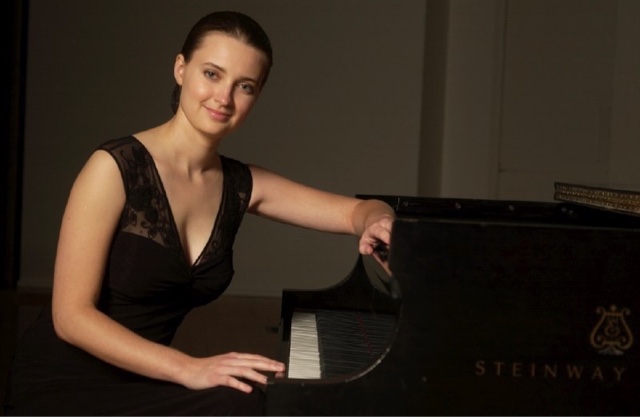
In my last CSO review, I wrote that I was looking forward to Anna Shelest’s return to the Cheltenham stage “with a great deal of impatience and musical greed”: especially for her performance of “Prokofiev’s (let’s be kind, and just say ‘challenging’ – two hands may not be quite enough: although I am expecting it to look like a gentle stroll in the park, after tonight…) second concerto” – intimating, of course, that this is one of the most difficult pieces in the concert pianist’s repertoire (and that was just from my being intimidated by the amount of ink in the score).

It does have a fearsome reputation, though – which may explain its ‘underappreciation’ when compared with his more popular third concerto:

It remains one of the most technically formidable piano concertos in the standard repertoire. Prokofiev biographer, David Nice, noted in 2011: “A decade ago I’d have bet you there were only a dozen pianists in the world who could play Prokofiev’s Second Piano Concerto properly. Argerich wouldn’t touch it, Kissin delayed learning it, and even Prokofiev as virtuoso had got into a terrible mess trying to perform it with Ansermet and the BBC Symphony Orchestra in the 1930s, when it had gone out of his fingers.”

One ranking – by pianist Pierre-Arnaud Dablemont – places it at the very top of “the five most difficult piano concertos” (and I thought that Brahms’ second was difficult – it only creeps in at number four…!); and, similarly, Paul Huang has this to say:

Prokofiev’s 2nd [is the most difficult piano concerto to perform] because of its 10+-minute, soul-crushing, endurance-testing cadenza. The longest in standard repertoire. It also has a notoriously difficult scherzo that lasts only 2.5 minutes or so but in which the pianist never stops playing 16th notes [semiquavers] in either hand. Not for a single rest. These notes have to be perfectly even and in unison. You can’t hide difficult parts with rubato. Make one mistake and you’re out of sync with the orchestra. You can't use pedal. Clarity is essential. Each note has to be articulated. To produce this effect is very exhausting. It requires fingers of enormous strength and stamina.

It wouldn’t surprise me, therefore, if I was not the only person in Pittville Pump Room to be experiencing (“hearing” seems far too feeble a word) this work live for the first time. But, wow, it was worth the wait! Although many at the première – coming just four months after the scandalous first performance of The Rite of Spring – obviously did not agree:

On the platform appeared a youth looking like a Peterschule student. It was Sergei Prokofiev. He sat down at the piano and appeared to be either dusting the keyboard or tapping it at random, with a sharp dry touch. The public did not know what to make of it. Some indignant murmurs were heard. One couple got up and hurried to the exit: “Such music can drive you mad!” The hall emptied. The young artist ended his concerto with a relentlessly discordant combination of brasses. The audience was scandalized. The majority hissed. With a mocking bow, Prokofiev sat down again and played an encore. “The hell with this futurist music!” people were heard to exclaim. “We came here for pleasure. The cats on the roof make better music!”
– Sergei Prokofiev: Brief Autobiography


This quite astounding work (and I mean that in a good way) – which, with its relenting pace (and absence of a true slow movement), is as much a challenge for the orchestra and conductor as it is for the soloist… – could only be by Prokofiev. And, despite the massed influences of various Russian predecessors – Tchaikovsky, Rachmaninov, Rimsky-Korsakov, Glinka, etc. – it really could only be by Prokofiev. With its use of classical structures, forms and harmonies to produce something essentially modern – indeed, this is essential Prokofiev. And at his greatest, I believe.

Here – revisiting the score, once home (and which I had open on my lap, in awe, during the concert); remembering Shelest’s incomprehensibly brilliant tour de force exposition – is my rather stunned account!

The opening Andantino lulls us into a Rachmaninov-infused sense of security. “Oh, we can sing along with this caloroso con gran espressione – it’s so beautiful”, you might say. But it soon becomes apparent that this is just a warm-up passage for both the soloist and audience. Forte arpeggios – followed by rolling hills of piano scales – produce a sense of foreboding. And a change of pace to Allegretto; and a new rhythm, repeated insistently four times – however ‘elegant’ the piano’s subsequent re-entry (to my ears, more mechanistic, more ironic…) – eventually leads to a passage of spiky ferocity. The storm has begun. And yet, there are thoughtful moments at a slower pace that can lead you astray… before, yes, the most gargantuan cadenza ever written (apparently, initially, scored for three hands – meaning much crossing of arms for Shelest) gets underway.

This is, effectively, the development section of the first movement – and yet it focuses on just the one theme: the piano’s opening Rachmaninovian melody, which soon disintegrates into powerfully-expressed exhibitionism and a momentous landscape of that dreaded black ink! And just when you think it has reached its fortississimo climatic conclusion… – with oscillating triplet semiquaver runs, over a foundation of leaping left-hand crotchets, spelling out a counter-tune (“one of the hardest places in the concerto”, according to the composer himself…) – it just keeps on going!

But Shelest handled it with aplomb: keeping that ‘hidden’ melody well-stressed and vocalized, despite the surrounding ornamentation. Immersed deep within the music (as well as the keyboard), her concentration never wavered; and, despite the ongoing acrobatics, and a collision of keys (of tonality – C# minor and D minor simultaneously – not bits of the piano falling off…), generously looked up at David Curtis, the conductor, to coordinate the orchestra’s re-entry. Although this starts softly… again, it is a trick – there is an immediate, time-compressed crescendo from piano to fortissimo; and the mayhem continues with the brass, emphatically underlined by the timpani, reiterating the very opening theme (originally lightly pronounced by the clarinets and pizzicato strings).

As always, the CSO heavyweights shook the very walls of the building. This was very much the effect they had produced in the final movement of Shostakovich’s Fifth Symphony – huge blocks of fundamental, elemental sound. Two lightning cymbal strikes: and the storm is over. (But, oh, to frolic under those dark skies; feel the heavy, wakening rain on your face; be so very in tune with nature…! There is joy in the mania; there is melody in the cacophony; there is enlightenment in the punishment. This is sadomasochism in music. And, boy, it felt great…!)

But, suddenly, we revert to that gentle opening soundscape – fading, fading, fading… – and the movement (like nothing else composed before or since) is complete.


Prokofiev has been accused of lightly orchestrating a piano sonata – but that closing of the first movement, and all of the second movement – that perpetuum mobile of a Scherzo – proves those critics wrong: there is some amazing, challenging string and woodwind writing (easily conquered by the CSO, as always) either side of the piano’s trickling, twinkling torrent of constant semiquavers. It is almost as if we are following the heavy rainfall from the first movement downstream – with its sudden mood changes – as it surges towards the sea….

Again, Shelest plunged in: never once, as far as I could see, lifting her head from the keyboard; keeping perfect time, with wonderful dynamic variations ebbing and flowing. To say that she provided a metronomic beat for the orchestra implies a lack of feeling – but this was expressive playing, surmounting the technical exercise that appears in print.

Such music must also be a nightmare to conduct – despite the constant 2/4 time, there are some astonishing changes of rhythm and volume – but, whatever fear (if any) he may have felt, David Curtis made it look relatively easy. He has built trust with this orchestra – as well as with Shelest – and it shows. The occasional interjections of brass (startling trumpet entries) and threatening percussion were utterly precise; yet somehow rendered this movement less ecstatic than it initially appeared. The flying arrows of the flutes and first violins also threatened to destabilize all forward motion. But everything punched in precisely on time. A fleeting motif in the cellos and oboe (which, only later, did I realize forms the basis of yet another bruising, baleful brass exclamation in the final movement) seemed momentarily to pull things together. But, on on we go! And then we stop. Just like that. Golly. All that music; all those notes – and so little time had passed.


You would think that a slow movement would be needed, after all that – especially for the soloist. And it is. But we don’t get one. Instead, the Intermezzo is marked Allegro moderato – and the instruments are told to play pesante (not like peasants – although they might as well be – but ‘heavily’…). There is no respite. And the members of the CSO gave all they had: marching as to war.

This is Prokofiev at his most Prokoviesque, you might say – and the sprightly piano entry (surely, the poor girl deserves some sort of break after all those semiquavers?!) just adds to the menace: mocking the orchestra’s stateliness with grotesque, off-beat chords, before a solo of surprising beauty. (If the Scherzo demonstrated Shelest’s technical prowess, this allowed her to return to the emotional lyricism of the first movement.) But this is a temporary state of affairs; and the mocking resumes – although what initially appears to be a climax dissolves into a light soufflé of arpeggios and runs, and more “light orchestration”.

Shelest then has a brief – again spiky – solo, before the orchestra decides this is a game it wants to play, too. Gradually, everyone joins in; there are a couple of menacing piano trills (with phenomenally scary muted brass accompaniment); the strings refuse to stop marching – albeit in slippers. But Maestro Curtis says “No more; no more”. His authority is final.


The Intermezzo ends quietly on a very low note: so, the astonishing fortissimo opening of the Finale, five octaves higher, felt like an attack of screaming demon angels from above. What initially sounds like a sprint – with Shelest jumping manically up and down the keyboard (figuratively; or fingeratively…?) – eventually resolves into a fragmentary theme; before a tempestoso climax. The thundering gallop of chords (reminding me of the cowboy movies that my dad is addicted to…), as the music forces Shelest to look like she may spread wings (there is no way to make this music look anything but utterly impossible to play – it is so physical…) – thus leads to that brassy reclamation of the Scherzo’s mini motif.

Suddenly, everything stops. Soft discords – bell chimes – in the piano are interrupted by unrest in the lower strings (was that ‘Dies Irae’ I heard…?). For a while, then, these are joined by the clarinets and bassoons, whilst Shelest finally – finally – gets the break she deserves! But not for long.

The succeeding solo passage is a simple, wistful one of great beauty – recalling the first movement, somewhat, in what could be described almost as a ‘lullaby’. (This also reminded me of the solo pieces of Mompou – such was its grace.) The bassoons (ah, bliss!) then take up this wandering theme, as the piano elaborates, and more and more woodwind and strings join in. (It is like being sung to sleep by a full chorus… – accompanied by a gargantuan brass band…!) The piano will not let go of the tune, though. Eventually, those woodwind and strings take over: upping the pace. A dialogue ensues. This is the rush to the end, isn’t it? Yes. The end. (In fact, the most final sounding, bloody emphatic cadence you have ever heard.)

But it isn’t. More trickery. I was waiting for someone to applaud. But we were so rapt: we could see from Shelest’s physical attitude that something was about to happen.

Indeed… a momentous, moody rumination develops from her earlier bell-like discords. And – oh yes – eventually, the bassoon comes back with its lullaby – but only so that Shelest can demonstrate her pugnacious, unrelenting virtuousity. A period of development (and swaying key changes) follows, before the mist moves in. The sudden foghorn blast that ends this short, spooky passage leads to a reprise of the beginning of the movement, and the real, build-upon-build, ever-growing climax. This really is it. The end. Fabulous. Reader, I wept. Reader, I cheered!


The applause and standing ovation given to Shelest was not enough. It never could be. She had partaken in the pianistic equivalent of a triathlon – simultaneously performing all three disciplines: technique, emotion, stamina… – and won. By a huge margin. This was heroic, amazing dexterity; beautiful, moving, percussive, lyrical playing. Astounding, unflagging talent that will stay with me for ever.

I never believed I would experience this piece played live. And, now I have, I do not want the experience erased, sullied by another performance. I simply cannot imagine the replication of such concentrated musicality. Instead, I will listen to Shelest’s recording on repeat, whilst gazing longingly at the tear-stained pages of the score she so gracefully signed.

This was a once-in-a-lifetime event. And all I can do is say a huge thank you to those who contributed. My night – or so I believed… – had been made.


But I had, of course, forgotten Maestro Curtis, and his handfuls of magic dust. Having already sprinkled a few grains on the CSO – their wizardry a necessary component of the Prokofiev – he shook his pockets out over the stage; waved his magic baton; and headed off for redemption via Stravinksy’s awe-inspiring Firebird Suite. If the Prokofiev proved the perfect vessel for Shelest, then this was the orchestra’s – equally proving their virtuosity in all departments.

No names, tonight. All players were inspiring: alone, and in combination. Reader, my soggy handkerchief was not enough. Someone please bring me a bucket…. (And better make it a double.)

This was joyous: an exhibition of control from Curtis, and delight from the CSO. It is as challenging a score, in many ways, as is the Prokofiev for the pianist. But the orchestra luxuriated in its difficulties, producing shimmering dynamics – who knew so many instruments could make so little a sound…? – and making changes of speed instantaneously. This was their showpiece. Or should be. A little bit of a miracle to end a wonderful evening…


…which had begun with Tchaikovsky’s Second Symphony – not, for me, one of his better works (and that is pretty much all I have to say on the matter – except that it was, of course, performed with as much energy and skill as everything else; conducted by a man with the happiest, most contagious grin in the Midlands – despite this being his fourth concert of the week…).

It made sense, really. If that (possibly nightmare-inducing) “lullaby” in the final movement of the Prokofiev had the insistence – and modality – of a folk song, then this was constructed from (at least) three of the real things: hence its nickname of ‘The Little Russian’. The Stravinsky, too, is folk-tune based. And so it made for a well-constructed programme – even if it was played in the reverse order of its original billing: a clever trick which made sense of the music, chronologically (sort of), and melodically.

Note
A more ‘formal’ – and much shorter – version of this review can be found on the Gloucestershire Echo website.


Postscript
By the way, I don’t really know if “crying is good for you” – it certainly feels it, to me (as it does to most): especially with music of this calibre, played so movingly, so flawlessly. Ergo, if men really are sobbing only “six to 17 times” a year (as a recent study indicates), I really do think they should start attending more high-class orchestral concerts, such as this; letting their sensitivities and sensibilities hang out; whilst perhaps channelling their inner Roy Orbison.

This was catharsis – what Aristotle might have called “the purging or purification of the emotions”, perhaps achieved through the witnessing of theatrical tragedy – of the most unalloyed, most curative kind.