Tuesday, 14 July 2015

A tale of two societies…


It sometimes takes a long(ish – only ever “ish”, with my health…) walk to settle my thoughts (and maybe yours, too?): and it was only after pootling around Packwood House’s meandering meadows and tree-lined byways that my feelings crystallized – seeded during time away relearning Dorset and Wiltshire’s delightful wonderments – and I realized how much I missed the place where I once lived; but how little I missed (and how much it stressed me) being connected permanently to the Internet (that is, of course, until I returned to Tysoe and a seemingly infinite queue of unread emails…).

As my friend Duke Senior recently opined – and reported (by email!) – though, whilst I was away on my travels in the land of the hill-fort, barrow and henge:

Dorset. A delightful part of the country, where there are still some old style ways of living, and virtues, to be found among the Hardy-esque rural bliss. Like it or not, we here in the Midlands, albeit as rural oasis in the midst of urban and suburban existence, are not like that. The question is, critically, how to retain the oasis-like qualities, when the historical agricultural foundations are somewhat fragile; and there appears little inclination or potential to foster alternative cottage industries, such as prevalent in Dorset, Somerset, Cornwall, for example. But there are heartening signs of all sorts of activities in the village, including overwhelming support for the Post Office, that suggest there are grounds for hope that something can be fashioned, to avoid this becoming just a commuter village, with retirement homes.

And thus it was good to find myself, as the PO was just opening – a couple of days after I had returned to this “better place” – at the end of a sizeable snake of villagers, wending its way towards the counter, eager to make use of its manifold offerings. As always, familiar faces filled the shop; and both conversation and service were friendly and welcoming. So, as June’s edition of Oxhill News reinforces: “Use it or lose it” (and contact Nadhim whilst you’re at it…)! Oh, and please walk there, if you can….


I only make this request, because, whilst incomprehensible rumours circulate of a third draft of the itself‑confusing (in both process and content) Neighbourhood Plan – which I had believed was on hold, whilst the Parish Council wrestled with it, and perhaps wrested back some form of control (it’s amazing what can happen when you leave the village for a short while…) – as well as a proposed/supposed “Simple English” or “Plain English” version – which makes me wonder what language the ‘official’ rounceval is in…) – there continue to be mutterings of “the risk of urbanization” in quelling the seemingly permanent rush of traffic on our tiny roads; as well as the massive increase of ofttimes dangerous/illegal parking outside the concentration of our public facilities (churches, school, village hall, shop, pub, hairdresser, etc. – including, of course, our threatened Post Office) – and not just at peak times any more.

But I do wonder if, maybe, some form of such controls/constraints are exactly what we need? Do we, as a community, really prioritize appearance and the picturesque above safety and common sense? (Hard to believe, I know, considering the attempted mass-Poundburying – like Bunburying, only different – diktats of the NP.)

For example: why not install a pelican crossing – or, indeed, pelican, crossing – outside Tysoe Children’s Group – where, possibly, the sight of a large, non-native bird with a beak full of fish – accompanied by other exotic fauna, elsewhere – would finally tame our speeding idiots/motorists…? Or even an Ettington-style priority system on entering Middle Tysoe from the Banbury Road, just before you hit (hopefully not literally) Church Farm Court; and/or on the Oxhill Road, before Windmill Way and Sandpits Road?

And I only ask this, because – on my many meanderings, walking stick as essential prop – I all too-frequently espy familiar, local cars parked in the centre of the village, no more than fifteen minutes amble from their points of origin; or ignoring the now freshly-painted road markings. (In Warwickshire dialect, the word ‘slow’, now writ large in several places on our byways in gleaming, titanium white, obviously means the opposite of what my grammar school English teacher beat into me: in the same way that ‘sick’ – I am informed by my backwards-wearing-baseball-capped intimates of a certain youthful disposition – means something is rather what-I-at-a-similar-age-would-simply-have-referred-to-as ‘spiffing’. And we are obviously using some longer parochial measure than the mile for our speed limit signs – a maximum, remember; not a target to be accelerated past as soon as the laws of physics permit….)

Perhaps (just for a change (ahem)) I am being cynical; but I do wonder (and not for the first time, of course) how many of these repeatedly-recognizable vehicles have crawled – or, in many cases, zoomed (watching the guys carefully laying down the new lines in Main Street made me realize how courageous you have to be as a Tysoe pedestrian: even in high-viz habiliments…) – half-a-mile or less, without the objective of travelling any further than the return journey home. And it is noticeable, coming back from the slightly behind-the-times-feeling south-west – although I’m not saying that motorists in Wessex villages are any better behaved (well, maybe slightly; and certainly more polite…) – how driving (and living) does feel considerably calmer away from motorways and major cities. No-one appears to be in the permanent rush that so characterizes the A3400, A422, A429 and the Fosse Way; and driving just at or below the legal limit is no longer punishable by Velcro-like tailgating or insane, risk-taking overtaking on blind bends and summits. Time (and traffic) seems to pass just a tad more slowly and sensibly….


I am sure that, if we really felt the need to install them, there are methods of managing vehicles and their speed which would not make the core of Tysoe resemble the centres of Stratford-upon-Avon, Warwick, Banbury, or Coventry. But I am equally certain that real improvements come from changes to behaviour, rather than systems.

As the World War II poster (and the motoring organizations, when there’s a light dusting of infrequent snow) asks: “Is your journey really necessary?” And, if it is, can you do it on foot (as I politely requested earlier); or by bicycle or bus – or even on the hoof…? And, finally, can you also do it calmly, and within the law? If not, perhaps you also need a vacation away from traffic both digital and mechanical…. I can highly recommend it….

Thursday, 9 July 2015

Never ascribe to malice…

In my long, varied, and deep experience, I have discovered that there are mainly two reasons for incompetence in any professional arena: namely, stupidity and greed. And they are not mutually exclusive: as is proven by the multi-storey car park developed (seemingly in haste – both from its makeshift appearance and its stunning lack of fitness for purpose (see below)) for the new Stratford Hospital – itself designed, apparently, to look like an ill-fitting conglomeration of partly-opened kitchen cabinets. If the Government is as keen to both commoditize (and subcontract) healthcare and create workhouse-like factories for the poorly-paid – especially those in the public sector – as I believe: then such architecture (and I use the term extremely loosely for something that has obviously been created by computerized machines with oversized egos, and no concept of the friendliness of the curved surface) will be a perfect environment (if not epitaph) for their joint demise.

According to Collins: “If you describe someone as incompetent, you are criticizing them because they cannot do their job or a task properly.” And, in my case, they are dead on. Doing a “job or a task” successfully does not – however right-wing your ethos – simply mean raking in money, or bringing a project in on time and budget. To function well, any facility must surely revolve around its users and their needs. But as George Osborne proved so adroitly, yesterday, such idealism, such ideology, such idiocy, is to ignore the slimy, hand-staining lure of profit. In this modern world of corporate scrounging and £93bn handshakes, the needs of the few (giant corporations) outweigh the needs of the many (little people) – as my hero Mr Spock would obviously never have said.


When the “phenomenon of our times” Owen Jones wrote, in his “phenomenal bestseller” The Establishment: And how they get away with it, that the “great carve-up of the NHS is a threat to the health and even the lives of patients”, I’m pretty sure he wasn’t thinking specifically about the bent-over-double pensioner who took around thirty minutes to exit the labyrinthine travesty that HUBER Car Park Systems – whose slogan, “HUBER guarantees long-term, efficient and profitable use”, says all you need to know about why they were hired – describe as “Project Stratford-upon-Avon”:

Huber has constructed a 250 bays public car park facility for the Warwick NHS Trust in Stratford-upon-Avon. The car park forms a first part of a wider development in Stratford hospital; the steel structure is timber cladded and is serviced by two staircases and two lifts. The project is the first to receive the bespoke HUBER LED fittings with advanced controllers which provide low operational costs without increasing the installation times and costs.

Nowhere can I find an explanation (or boast) of how their “system” (however unsystematic in practice) benefits its actual users: with its overly-complex, indecipherable, automated ticketing machines; its narrow lanes – meaning that cars (especially the archetypal Warwickshire behemoths) cannot pass each other without great difficulty; and that all the multitudinous sharp corners must be taken (slowly) only in the few magical moments when there are no oncoming vehicles. It’s as if they have turned best-practice on its head to squeeze in as little investment, capacity and practicality as possible. (That’s why only 2% of the spaces are Disabled bays, of course.) For a service that deals almost exclusively in humans (you know what I mean: those soft, squidgy moving objects…) who are damaged in some manner, it seems to me that HUBER (and those who hired them) have deliberately gone out of the way to engineer an increase in the number of casualties entering the hospital: injured in the inevitable physical clash of SUV bumpers (with each other, as well as with disoriented stragglers); or mentally weakened by the tortuous, unmanned (ta-da: no fallacious living wages to supply!) payment gadgetry.

Were it not for the burly, hard-hatted, high-viz-jacketed saint who just happened to be passing by, I fear that the old gentleman, in obvious pain, and confused beyond belief (but ignored by those many hurrying folks besuited and lanyarded with NHS ribbons and tags), would still now be leaning on his stick, and the boot of his car, breathless: wondering both how he was going to shuffle across the incessant traffic entering, leaving, and almost-colliding; and then operate the Terminator-redux towering over his tiny, distorted frame. I admit that I was no help, either: as I too was befuddled and angered by the difficulties we were both having merely in attending for supposed healthcare.


According to the Hospital’s own website:

There are exciting plans to build a new state of the art hospital in the centre of Stratford. The first phase will provide first class Cancer [sic] and eye services for local residents of Stratford and surrounding districts. Without these services near to home, patients previously had to travel long, tiring distances to other facilities which are further afield to receive treatment. In some cases cancer patients decided to go without their treatment as they were unable to travel long distances every day, when they may already be feeling weak from treatments.

It also says, under “Creating a pleasant environment”:

We understand that a visit to hospital can be a challenging experience. We want to ease this and help our patients and their relatives feel as comfortable as possible during their time with us. Our aim is to use charitable funds to create a homely and less institutionalised environment for the people that use our services. Research has shown that the environment in which a patient is treated can have an impact upon the healthcare outcomes. By developing a space that is theraputic [sic] and supportive of family involvement we will be able to reduce anxiety and stress, something that can aid recovery.

Which I can counter with only one word (and which The Good Lady Bard will tell you is my favourite and most-uttered) – bollocks. It is all well and good to spout such badly-crafted homilies; but it takes more than a jobbing copy- or speech-writer to turn them into customer-oriented, user-friendly reality.

Now, patients have “to travel long, tiring distances” simply to pay for their car-parking – which is only not free for the disabled because that would need the attendance of a costly human-being to monitor. And there is no doubt in my mind that “the environment”, as it stands – with its large ladling-out of “anxiety and stress” (which, of course, retards recovery (oops)) – can only have a majorly negative “impact upon the healthcare outcomes” of anyone trying to arrive under their own power. I would not be surprised if, as a result, there was soon a further increase in patients deciding “to go without their treatment”. Personally, I would rather drive all the way to Warwick or Oxford, than have to go through the struggles I and my disabled colleague endured yesterday.


There is one drop of comfort in all this. According to the architects:

The new hospital… will include a new… energy centre and public realm as part of the strategic masterplan.

I would like to nominate myself to be the first leader of this new “public realm”, please (having first received some much-needed “energy”…)! And, if ruling it necessitates gratuitous violence (as I hope), Game of Thrones-style, then I would also like to nominate the car-park designers as my first victims. My weapon of choice will, of course, be a carbon-fibre-shafted walking stick, wielded brutally from my large Japanese war-chariot. There will be blood.

Thursday, 25 June 2015

Things are looking up…
(or ‘That’s Entertainment’…)


Once, in a particularly insalubrious pub, an old man with a face like a wet leather satchel gripped my forearm, locked his milky blue eyes on mine, and enunciated very precisely: “Never forget to look up, son. Never forget to see what’s around you.” The utter drunken seriousness with which he imparted these pearls of wisdom gave me pause. I remember staring blankly at velveteen wallpaper and a middle-aged barmaid with a wide smile and a deep cleavage, and thinking that the oracle of the Nag’s Head had probably had enough votive lager. At the time, it sounded trite. [Now] it makes more sense than ever. I feel like I’ve rediscovered my own country, found a series of secret rooms in a house I’ve lived in for my entire life. The reality is that England has some of the most inspiring countryside and driving in Europe, if not the world. We have every type of road, and far too much weather. We have excitingly stupid wildlife, and views that make your jaw hit the floor while your brain struggles. But, best of all, we have the freedom to enjoy them, as long as we make the effort…. Put simply, we should heed the advice of small, drunk old men in pubs, and remember to appreciate what we’ve got on our doorstep. We should look up, and look around. And get out there and do it.
– Tom Ford: Top Gear magazine

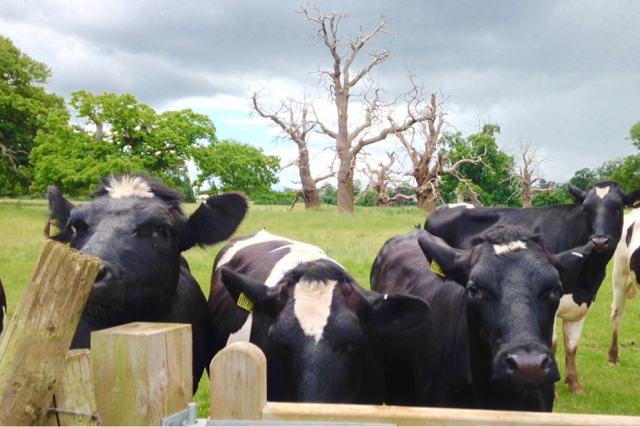
You meet some funny (meaning ‘strange’; and sometimes ‘unusual’) creatures when out on walks – and not just in Tysoe, either. Earlier in the week, on this “slow-time Monday” – but not for the first time – I came across a group of Ents having what my dad would call a ‘confab’ (more properly, of course, an ‘Entmoot’).

The few, sparsely scattered, other folk following the park walk trails at Hanbury Hall appeared totally oblivious – were in too much of a rush to complete the course, their goal; or, even in their leisure, just weren’t interested in the “unhasty” nature of the discussion. And, to be honest, I would have passed them by, too – intently admiring the restoration of George London’s early eighteenth-century landscape; and listening to the busy birdlife and the sheep’s echolalia – were it not for the assembled young cattle, all singularly rapt in ruminative attention. There was obviously wisdom to be imparted, and to be absorbed.


If I had not “looked up” – habitually concentrating on avoiding bard-traps in the ridge-and-furrow, and putting my already-soiled boots once more unto the the copious amounts of sheep and cattle droppings – I would not have spotted the Ents’ wise and friendly faces above me: looking down (but not in the patronizing way that implies), welcoming all who would stop and tarry a while, as is their wont. We should therefore be grateful to “the Elves ‘curing the Ents of their dumbness’ [and] that it was a great gift that could not be forgotten”: for, if there are to remain guardians of this fragile planet, it is to them we should look and listen, and take great heed.

After mutual introductions had been made – at length; and in a relaxed-but-formal fashion very much to my liking (“Decided? No, we’ve only just finished saying good morning…”) – and after being complimented on dressing appropriately in raindrop-repellent ’roo bush-hat and showerproof fleece (there was a threatening Edward Seago sky: which would soon deliver on its dark promises) – the tallest of the Ents asked me if I had yet visited the last of their nearby wards: the black poplars, on the edge of the old deer park. I responded that I had; and that I had wondered – admiring them, their solitude and fortitude – what supernatural presence had protected these unfamiliar beings – “the most endangered native timber tree in Britain” – from prevailing destruction. Now I knew. And was thankful.


These trees, although commonly seen during the middle ages, found it difficult to adapt to modern agricultural and woodland management methods. Today they are rare so we hope to plant more using cutting from these trees.
– National Trust: Hanbury Hall park walks

As is their modest way, the Ents – as “Shepherds of the Trees” – regretted that their efforts had not been more successful, more numerous; but were pleased that – albeit almost too tardily – we humans (at least some of us) had finally begun to appreciate what lay around us; how such life – “The force that through the green fuse drives the flower… that blasts the roots of trees” – was precious beyond jewels, beyond anything man-manufactured. “Would that the trees might speak on behalf of all things that have roots, and punish those that wrong them!”


Eventually, I had to leave them to their concerned contemplations, and continue on my way. Their leader bowed from his great height, and held me gently by the hand – his bark much gentler, less craggy, than its sight would imply – and thanked me for my time. I replied that it was freely given; that I was grateful for their involvement; and that I would soon – by their measure – return. It was time well-spent, I said; and most, most valuable.

Noticing, as I moved on, that they were not marked on the provided map, scrumpled into my jeans pocket (and now lying before me, as I write), I wondered where I would next encounter them. I was sure that, whatever their ubiety, the poplars would be well within their sight; and that, if necessary, they would find me.


Passing through the burgeoning woodlands, after skirting Goodwins Hill Coppice; and before ascending the grassy slope to St Mary the Virgin Church – beautifully situated, with gorgeous panoramas (over the Vale of Evesham, back towards the Cotswolds), and backed by the dense Church Coppice – the conversation stayed with me: and I viewed all the trees I encountered (the older ones often acting as shade and shelter to the estate sheep and their now well-grown lambs) with fresh vision. I wondered, though, if the Ents would approve of the beautiful decorative carpentry within: much of it – including a pair of eye-feasting, neck-breaking, barrel-vaulted chapel roofs – originating from the Vernon family’s (the founders and then residents of Hanbury Hall) major restoration of 1840. The land is now well-managed and -loved; but, all those years ago, were the originating woods replanted to replace those toppled in the name of creed and craft…?


It was only upon leaving the church that the foreshadowed rain finally fell. As I reached the bottom of the hill, just before I reached the avenue of fortunate oak trees (almost sold for timber, in the early 1960s, by Doris Vernon, the widow of Sir George Vernon, “to raise some extra funds”; but saved by the National Trust on “a surprise but well timed visit”), I walked into a grey wall of wetness. An unfortunate couple in lighter clothing had to be rescued by the farmer, who had been herding the sheep from field to field – bouncing the poor, drenched souls back to the comfort and respite of Hanbury’s servants’ hall tea-room, in his covered John Deere Gator (a vehicle I am still trying to persuade my dear Lady Bard to buy me for my birthday…!).

Was it purely coincidence that the trees saved me, with such perfect timing – like a lamb to the water… – from being soaked…?


Wednesday, 24 June 2015

First-rate Ford…


In far too many reviews of Love’s Sacrifice, to my mind, the crux of the critics’ argument is that much-vaunted trope, that John Ford’s play is “second-rate Shakespeare” – but that, I think, is to miss the point completely (unlike a trio of the cast: who end up rather vigorously blood-stained…). Maybe people do purchase Škodas, regretting the fact that they have bought a ‘second-rate Volkswagen’ (although, when they drive it, they will not be disappointed; nor with its longevity); or flick through paperback books, wondering if the words would have jumped more livelier from the page if they had not succumbed to the cost-effectiveness of a ‘second-rate hardback’ (or even Kindle)? To compare Ford to Shakespeare (or Shelby (sorry)), though, is meaningless – and trite – a simple – nay simplistic – hook from which to hang your well-creased critical cloth.

Okay, I admit, it is difficult to attend a play at the Swan without bringing Big Bill to mind: but surely, “the play’s the thing”, and should be judged on its own merits? As Martin White – who directed a crucial student production of this “lost masterpiece” in 1997 at the University of Bristol – comments in the programme notes:

The RSC’s Swan Theatre was opened in 1986 with the aim of reviving plays from 1570 to 1750, and many of the productions staged there have offered audiences the chance to see some forgotten plays and so expand the repertoire of early modern plays…. In 1604 the playwright John Marston wrote ‘The life of these things consists in action’.

And, in his astute, erudite, thorough and entertaining introduction, editor AT Moore concludes that…

Long dismissed as a poor mish-mash of Jacobean tragic conventions, Love’s Sacrifice is a challenging, ingenious drama which touches on – but does not wholly articulate – perceptions of women as the bearers of authentic and defensible thoughts and feelings. The uncertainty raised by these perceptions haunts the play, contributing much to its uneasy mixture of baroque lyricism, mannerist doubt and even absurdity…. Ford has dared to put on stage what he imagined, however awkward or provocative that may prove to be…. Love’s Sacrifice manages to be both ethereal and worldly about romantic passion, and to express, in the contradictory fabric of its language, action and dramatic form, a capacious vision of love.

…and I agree. I know that many critiques, nowadays, rely majorly on comparison and derivation: but that’s not really my way. Just to say: yes, there are echoes, for example, of Othello – but should we say that about every play that features a jealous husband? – as well as Hamlet – but do we roll that out every time our melancholy hero spirals into madness and dies? – but Ford is a much, much better writer and dramatist than that (as Moore intimates); and the scattered plot references are no mere mimicry: they are developed, used sparingly, commented upon, sometimes twisted, and used as devices in themselves – all facets that its original seventeenth-century audience would have appreciated, understood, acknowledged… and then patted themselves on the back for recognizing and being so fantastically intelligent! Martin White explains that Ford “expects his audience to ‘read’ his plays with that awareness”. But this doesn’t mean that modern patrons won’t ‘get the joke’ – even though current repertory is so different – or, to be honest, that it matters if they don’t. They will see the play through modern eyes; through a modern performance that shows them, gives them, what they need. And this one does it in spades….


For a thoroughly period production, it is a brave step – but one that works incredibly well – to feature such contemporary, almost Bartókian, chamber-music – by Alexander Balanescu – a string quartet of stunning passion, with supplemental, atmospheric percussion (and uncredited voices). This was in no way ‘incidental’, but key to driving the action on – and, if I did have any sort of comparison in mind, it would be some of the better episodes of CSI: Crime Scene Investigation.

The set design by Anna Fleischle – with ingenious echoing, diminishing arches and mood-ramping back-projection – partnered with Lee Curran’s perceptive lighting – including a rather inventive chess motif (which, sadly, may not have been entirely visible to those not in the gallery) – showed that the creative team (including director Matthew Dunster, making his RSC debut) had taken the play at its merits, and enthusiastically given their all.

The company (many of whom can still be seen in the rip-roaring The Jew of Malta – reviews here and here), too, demonstrated their intensity, their belief, their immersion, at every opportunity. In fact, it would be hard to criticize any of them: but special mention must go to Matthew Needham’s ardent Duke of Pavy – “I am Caraffa, he, that wretched man” – Jonathan McGuinness as slimy, conniving “arch-arch-devil” D’Avolos; Andy Apollo as “overworked gigolo” Ferentes – “Chastity? I am an eunuch if I think there be any such thing” – and, of course, Matthew Kelly as “old antic” Mauruccio, whose redemption of sorts – “Adieu to all, for lords and ladies see My woeful plight, and squires of low degree” – feels deserved, despite his “musty theatricality”.


I would normally, therefore, recommend that you grasp the chance to see this production with both hands: but, “Pity o’ my wisdom”, tonight is its last performance. Stupidly, I had taken its earlier criticism at face-value; and only a spur-of-the-moment decision prompted us to go. Having read the text, though (especially in Moore’s wonderful edition), I had been utterly drawn in; my expectancy utterly rewarded – and should have known better, and to trust my own judgment. You won’t find me making that mistake again!

No age hath heard, nor chronicle can say,
That ever here befell a sadder day.

Tuesday, 23 June 2015

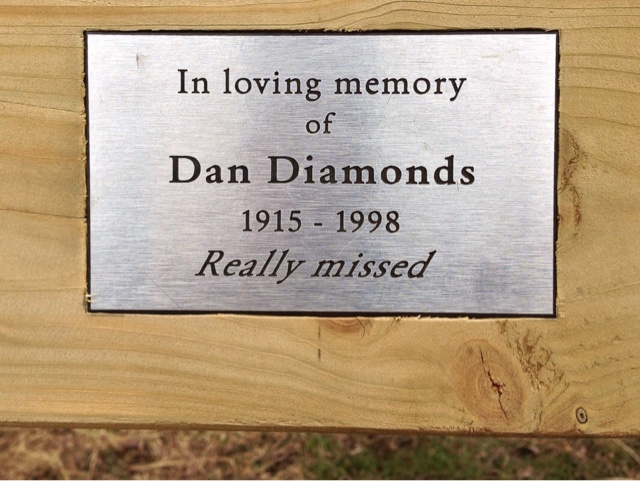
Composed upon Stannals Bridge, June 23, 2015…


I have rested on your bench so many times:
     faced the blind sun;
          dreamt of poor rhymes;
     but never really thanked you,
          or those you left behind –
who really miss you still – for being quite so kind

as to leave this limping poet a handy place to sit,
     when halfway round his walk,
          to rest a bit… –
     So thank you, Dan Diamonds:
          a shining soul so worthy of such name;
I am glad for your memory; and happy that you came.